Showing posts with label cleantech. Show all posts

Friday, February 05, 2016

Financial Sarcasm Roundup for 02/05/16

I avoid watching politicians debate each other on TV because I have more important business tasks to accomplish. I realize I'm giving up a huge source of inspiration for sarcasm. Oh well, we can't have it all in life.

Here comes a new oil barrel tax to fund green technologies. The UN COP21 architects would be proud. I have no problem with this fee. It will destroy part of the US shale industry, but that's to be expected after years of overinvestment in wells that are only economically viable at higher oil prices. Kermit the Frog once said that it's not easy being green, but he didn't mean green energy.

The IMF lectures China on getting into better financial shape. Good luck with that one. China is flailing around for a workable economic policy. Beijing cannot admit that its Ponzi scheme is unraveling because it can't afford to frighten away the Western investors who were dumb enough to start trading the yuan onshore. The IMF can't afford to look bad after adding the yuan to its reserve basket. It all looks like two poker players in a televised tournament who know they can't bluff each other anymore but are still bluffing the audience.

The mortgage bond market just isn't much fun anymore. Taking the punch bowl away is good news for responsible homeowners because there will be fewer secondary bids for mortgage products that should not exist. Issuing paper backed by other paper is usually pretty dumb. Of course, if the Federal Reserve ever had to sell a big chunk of its MBS holdings, the banks would have to hire back MBS traders in a hurry. Catching a falling knife is usually pretty dumb.

More political debates are ahead. They won't mention any of the issues I blogged about here. That's too bad.

Monday, November 23, 2015

The Haiku of Finance for 11/23/15

Startups pitch green stuff
Magic tech cleans the planet
Living the profit

Mastering The Cleantech Open Global Forum 2015

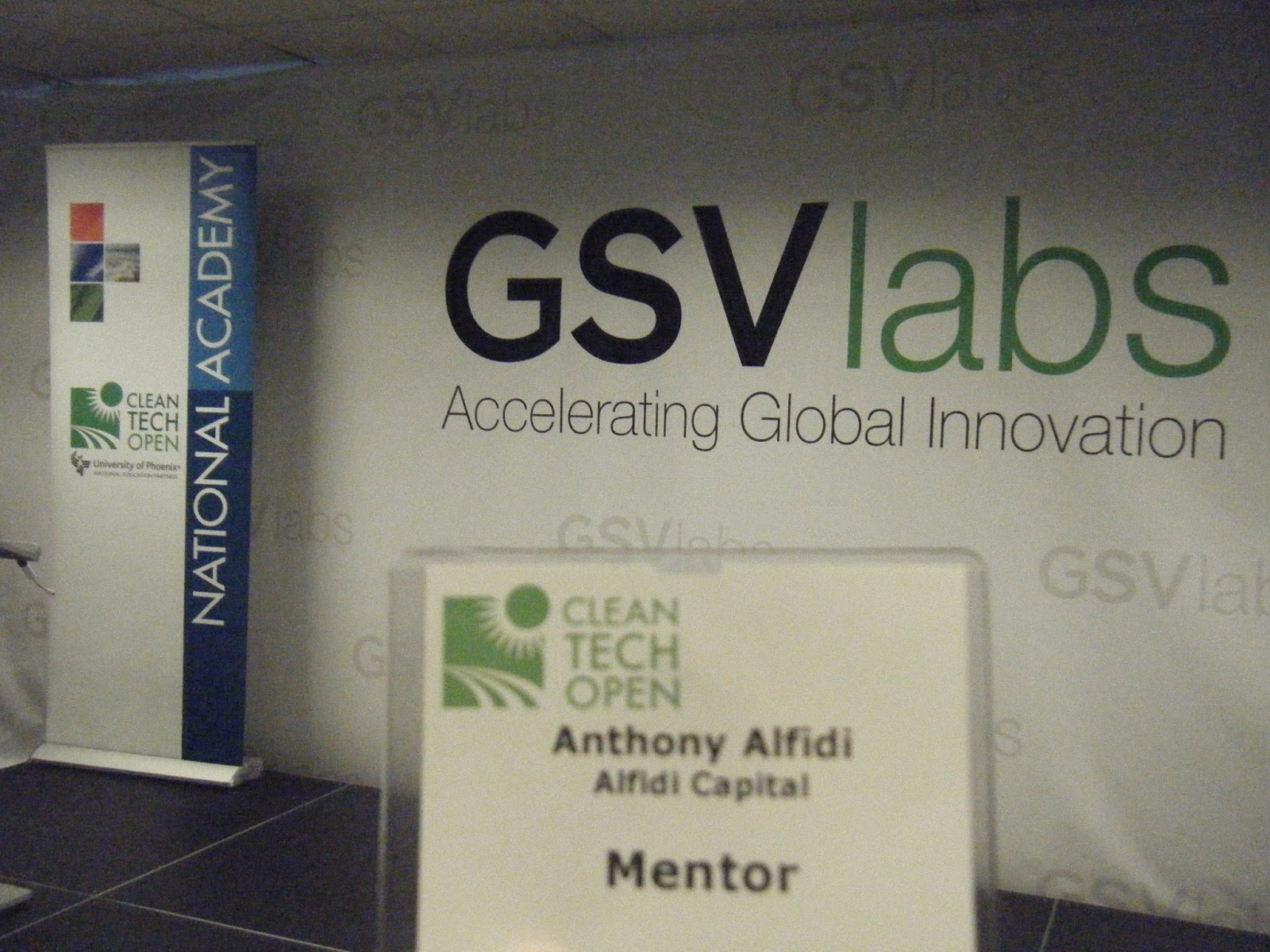
I have attended the Cleantech Open's events for three years now and I always come back for more. I had to jump into the CTO's Global Forum 2015 last week to see what this year's class of startups had done. Badge selfies are my bona fides because they prove I am not some AI bot randomly generating blog content.


Driving down to the CTO's home at GSVlabs is always worth my time. The co-working trend is now a serious thing. Startups eschew privacy and security by taking open-space collaboration to an extreme. I think the next trend could be co-working outdoors, where startups can plot their huge markets on picnic tables. Nah, just kidding. I wouldn't want to do office work outside because wild animals like bears and coyotes run around out there looking for people to eat. Smart VCs won't fund a startup where the founders risk getting devoured by packs of wild beasts.


The Investor Connect speed-dating round had a table reserved for yours truly, the CEO of Alfidi Capital. Someday I'll be #1 but this time I was at the #2 table. I am usually the #1 genius on hand wherever I go in life. Most normal people recognize this as soon as they meet me. Serious VCs and angel investors were at the other tables and I had the chance to interact with a few of them during breaks between meeting startups. Sharing insights helps me understand how much startups learn during their early phases.

I will share what I learned from the startups I met at my table. These are general impressions that cover many verticals. Addressing a scalable market means going after a big demographic whose price points and buying power are easily understood. Going after boutique markets with fragmented demographics (like organic farmers, for example) means a startup's marketing channels will be less efficient. Lowered efficiency in anything, especially finding a marketing channel, means a startup needs a longer runway to profitability. Proprietary technology must be difficult to duplicate. A simple device with common components is easy for a competitor to reverse engineer.

I also attended the CTO's Celebration Day in San Francisco's Herbst Theatre. It was my first visit to the Herbst since the Veterans Building's renovation. The drinking fountains on multiple floors actually work now after several years of inactivity. The downstairs bar looks pretty snazzy. Dag-nabbit, I should have taken photos.

The winners and finalists ran the gamut of tech. I heard pitches from startups doing biomass gasification, carbon nanotubes, pollution tracking, and SaaS analytics. I can't connect with businesses outside the United States because my personal prerogative is to only work with companies located in the US that American citizens own. I'm sure there are plenty of those to find.

Famed VC Ira Ehrenpreis gave his keynote that doubled as a highlight reel of his favorite investments. I'm pretty sure I heard him give this talk before at a conference down in Silicon Valley at least a year ago because I recognized many of the slides and themes. He told us that the best time for tech investing is right after a sector bursts its bubble, because the final survivors are in the best position to be long-term winners. I think the solar sector is still in the middle of its shakeout, so anyone making panels or modules after the last low-quality Chinese producer goes bankrupt will be in a sweet spot. I also think solar suppliers that adhere to all of the DOE EERE SunShot Initiative's standards will have an easier time convincing developers to include them in supply chains. Ira also mentioned the "second bottom line" importance of ESG criteria, another set of guidelines our aspiring startups must adopt if they want to attract impact investors.

I noted one concluding quote with interest: "There's no such thing as a bad contact, but there is such a thing as a bad way to follow up on a contact." Well, I had plenty of bad contacts when I worked in sales, and plenty more when I was between jobs trying to make a career for myself. There really are tons of bad people in the world and they succeed in spite of themselves. I avoid those types because I'd rather meet the ambitious folks populating the cleantech sector. If I get rich after investing in one of these startups, then I could finally afford to be a big-shot sponsor of the Cleantech Open.

Sunday, June 28, 2015

The Haiku of Finance for 06/28/15

Get cleantech action
Serious startup wisdom
Accelerate now

Hitting Off at Cleantech Open National Academy West Coast 2015

Most of you know that I enjoy mentoring startups.  I get my kicks out of it for the third year now that the Cleantech Open has kicked off its 2015 season with the National Academy sessions for the West Coast.  I attended the show down at GSVlabs on the peninsula this month.


I used to hear a lot about traction at startup conferences.  Luminaries have finally come around to defining traction as sales revenue.  All of the third party validation proving a technology's function means little if no one wants buy its output.

Guy Kawasaki had a new acronym for us to master:  MVVVP means Minimum Viable Valuable Validating Product.  I prefer the original formulation of a minimum viable product (MVP) because it focuses solely on the tech's workability.  The value and validation come not from the MVP tech but from the target market.  Guy's other formulation of Milestone, Assumption, Tests, and Tasks (MATT) is useful for motivating a startup's daily accomplishments.  I had to LOL at the mention of the "bozo explosion," where lame executives hire less capable people than themselves, which leads to an inevitable collapse.  It takes a lot of courage to hire people better than yourself.  I can't hire anyone like that because no one is better than me.  That's why I work alone.

I did not know about the Biomimicry Institute's Global Design Challenge prior to the academy.  I have known about biomimicry ever since Dr. Hunter Lovins presented the subject at the Commonwealth Club a decade ago.  Cleantech people should look to nature for inspiration rather than reinvent the wheel.

Entrepreneurs must link Customer Development and the Business Model Canvas as a holistic effort.  Using a capital-efficient framework is implied in those models and the Cleantech Open's experts made it official.  CustDev will quickly and cheaply eliminate unworkable hypotheses.  One speaker mentioned Rob Fitzpatrick's The Mom Test as the exemplar for explaining a business model simply.  The irony is that these approaches require brutal honesty between customer and vendor.  In my experience, most human beings abhor honesty.  People have fired me from jobs, ejected me from social networks, and threatened me with physical violence for being brutally honest.  It's easier said than done.

The Chasm Institute had plenty of tools for startups to work through as they "cross the chasm" from early adopters to mass adopters.A product's inherent complexity can be a barrier to mass adoption, so further product iterations should resist the temptation to over-engineer it with undesired features.  I'll bet that startups who successfully leverage their partnership networks can cross that chasm.  Startups tend to overuse the word "partner" without differentiating whether partners are in their supply chain, manufacturing value chain, or marketing channels.  Marketing channels are the path across the chasm.

Entrepreneurs had plenty of time to work on their pitches at the Academy.  Brand audits and SWOT analysis enable better storytelling.  The "Weissman score" is not a plot device anymore and information scientists are beginning to use it seriously.  We'll know the score has gone mainstream when content marketers start publishing test results from web properties.  Data science doesn't connect emotionally with a mass audience.

Conventional wisdom on pitches now includes use of Marimekko charts and 2x2 metrics.  Look those up online for examples.  Marimekko charts illustrate market segments, showing how a market strategy can reach different segments as a startup achieves milestones and collects capital injections.  The 2x2 matrix shows a product's differentiation within its sector.  Those things are effective visual displays if entrepreneurs have robust marketing data.  Making up stuff is not acceptable.  Investors want to see how tech development milestones reduce risk.

Here's one of my new pet peeves about venture capitalists.  Some VCs claim they don't understand business models that are heavily dependent on subsidies for financial viability.  Pfffftttt, yeah right!  Everyone in the Valley loves Tesla Motors even though subsidies and tax breaks rule its financial viability.  The same goes for its twin, SolarCity.  The whole cleantech sector would not be where it is today without massive government subsidies de-risking things so scaredy-cat VCs can jump in later.

I need to grab a copy of Sull and Eisenhardt's Simple Rules because they went like hotcakes among the Cleantech Open crowd.  My simple rules at Alfidi Capital are to be honest, publish daily, and attract hot babes.  The "two pizza rule" for product development teams is still popular.  I would jump into more product development roles as long as I'm not paying for the pizza.  Oh yeah, being cheap and scoring free food are some other simple rules I use.

Government labs are serious about getting the private sector to use their assets.  The National Energy Research Scientific Computing Center (NERSC) offers free supercomputer access for companies.  Whoa, that's a heck of a deal.  It may even be better than free pizza.  DOE Small Business Vouchers are also encouraging startups to use government labs.  Startups jumping into these programs need to link their participation to their Technology Readiness Level (TRL).

It's good to see large corporations use a corporate development philosophy that includes reverse logistics and life cycle termination.  One corporate development participant here described a whole slew of supply chain services they offer to help startups with product delivery.  Wow, here's how partnering makes a difference on the back end.

The Band of Angels showed up to describe a convincing financial narrative.  I am not convinced that there is publicly verifiable proof of a connection between contact frequency and closing sales.  Venture Beat published an excellent article in 2014 about how some commonly quoted sales statistics are worthless.  I worked at a major wealth management firm from 2005-06 where the best sales people closed all of their business with one contact.  It was easy for them because their rich families gave them all of their money immediately.  There are other ways to be convincing besides citing statistics invented out of whole cloth.  Once again, emotional hooks and the early involvement of financial backers make a big difference.  People from Band of Angels are generally pretty cool.

Someone mentioned CAGIX but did not describe how to use it.  Another guru suggested bargaining for discounts from supply chain partners based on how they benefit from a startup's product.  I think that would work if the startup has CustDev data to back up any claims.  Since introductions from referrals are now the norm among venture capitalists, it makes little sense to even run through the traditional pitch fest circuit.  The reality of VCs throwing money away passively is even more depressing than their reliance on inbred referral circles, but that's why many of them fail.  I am not surprised that Silicon Valley's elite have become so insular.  I expect the next tech sector crash to sweep away the ones that have added zero value.

Bill Reichert always excels when he teaches us how to "get to wow" when pitching.  Venture capitalists are only human, as I described above, and they invest when they fall in love with a team.  You can read his wisdom online so I don't need to repeat his thesis here.  I do need to repeat his warning that entrepreneurs should not lie, because too many of them think lying is okay.  I have personally met people in the startup community who excuse lying as an "everybody does it" thing.  That's one reason why almost everybody fails at startups. Investor due diligence uncovers lies about founders' backgrounds.  Customer due diligence uncovers product flaws that destroy reputations.  I could go on but only a few honest people on the planet will ever grok what I say about integrity.

The closing keynote on how society is transitioning from coal to solar was a big winner.  Scarcity makes some energy sources more expensive, but tech advances are making solar cheaper.  Thermal coal prices are certainly crashing as utilities switch to cheap natural gas.  I concur with the broad argument that the coal sector is in decline and deserves Wall Street's short interest.  I do not know at this time whether non-coal substitutes for metallurgical coal are viable.  The metal refining sector still needs coke for steel production.  Clean coal technology also exists, and it may extend coal's viability if it reduces carbon impact or produces attractive byproducts (i.e., CO2 feedstock for algae-based biofuel).  The lack of obvious non-coal substitutes for steel making mean coal companies with large metallurgical coal deposits may be bargain plays.  Some part of the coal sector will still be viable for several decades regardless of the energy sector's trends favoring solar over coal.  This is the heart of an Alfidi Capital thesis I shall develop in future research.

I normally get plenty of unsolicited attention at these types of business events.  I was on my best behavior at the Cleantech Open 2015 academy.  Mission accomplished.

Friday, November 21, 2014

The Haiku of Finance for 11/21/14

Next cleantech pivot
Bring Big Data into mix
Venture cash will flow

Startups Shine at Cleantech Open 2014 Global Forum

The Cleantech Open held its 2014 Global Forum on San Francisco's Treasure Island and I had a first-hand view of the action.  My direct involvement this year culminated with the previous day's final pitches and investor connect speed rounds at a Financial District hotel.  I stayed for the Global Forum because thought leaders invariably have insights that make my day.


I won't disclose anything proprietary from the pitches and speed connections on day one, but I do have some random thoughts to share.  My general impressions of this year's startups were very positive.  Most of the startups I directly observed presented business models that were mature enough to deserve investor due diligence prior to funding.  That is a high bar to pass and it speaks well of the program's volunteers who helped the startups refine their plans throughout the year.  The most thoughtful startups recognized how their business models leveraged something beyond their core technology, like marketable Big Data or the potential for extended servicing.

Here is the singular cautionary tale.  One participant I encountered seriously expected the financial model of any business focusing on a developing country to need a liquidity buffer, but not for the usual unforeseen problems.  He envisioned the buffer to accommodate payments under the table, as if he expected Foreign Corrupt Practices Act (FCPA) violations.  The people around him chuckled but I do not consider that to be a laughing matter.  One startup had a savvy strategy to leverage a local culture's shaming traditions if a corrupt official stood in their way.  I would suggest a mitigating strategy of anti-bribery clauses in legal agreements for franchises and joint ventures.  This means pulling the franchise agreement of any local partner caught bribing an official, and reporting the incident to both the US and local governments.  I have a low opinion of American business people who suggest that FCPA noncompliance is excusable.

The CTO's corporate partners pitched their support services prior to the speed dating round on the first day.  Wells Fargo is stepping up with its Innovation Incubator.  I also discovered the Wells Fargo Startup Accelerator for financial technology ideas.  I'm glad I bank with the Wells Fargo stagecoach.  I missed the NREL Industry Growth Forum this year but it will go on my calendar in the future.  These sponsors are careful to structure their services and partnerships in light of recent IRS rulings on open source innovation,  Corporate sponsored non-profit incubators must share their results with the public to preserve the sponsor's preferential tax treatment, in a nutshell.

The Global Forum introduced Stanford's Energy Transformation Collaborative.  The courses look challenging but the research grants available are more immediately relevant to startups.  One speaker mentioned how policies should address different technology readiness levels (TRLs), with research for earlier stages and market incentives at later stages.  I grok the appreciation for innovative business models that made it big, like Tesla Motors and SolarCity, but they still have not proven any consistent profitability.  The cleantech sector can gain credibility with less blind worship of innovation and more respect for a Warren Buffett-style durable competitive advantage.


Former Baywatch actress Alexandra Paul spoke to the CTO crowd about her environmental activism.  She looks rail thin in person, as you can see from the photo I took just above.  I was thinking someone needs to get her a cheeseburger ASAP before a strong wind blows her away but she's a committed vegan.  She wore this black pantsuit that was practically transparent, showing off her toned figure.  Her body of film work is as memorable as her physical body, especially in many scenes where she's in her birthday suit.  I would have preferred to see her take that transparent suit off at the Cleantech Open but we had to keep things clean (pun intended).  Her talk was full of data-free emotional connections to environmentalism that offer classic insights into how laypeople approach cleantech.  I'll bet a bunch of publicity-hungry media types in Hollywood and Beverly Hills would be pushovers as early adopters for any high-priced cleantech product they could show off to their peers. 


Venture investor Steve Westly gave a version of the talk I heard him give at SVIEF months ago where he touted his portfolio investments.  It's perfectly okay to pump your successes and I do it all the time on my blog.  Steve wants next-generation cleantech innovations that offer higher gross margins at lower capital requirements to launch.  I totally agree with his expectation that stress on the Himalayan watershed will drive conflict in Central Asia, but IMHO cleantech innovation isn't going to prevent that conflict.

The investor panel was stacked with experts from Cisco, Band of Angels, Sidley Austin, and Roda Group, and Wells Fargo.  If I had been on the panel, I would have opined that private investors won't fund basic research without a clear path to commercialization.  Well, I wasn't on that panel, so I'm saying it here.  Federal and university labs should do that basic research.  I also suspect that venture funding trends are driven by media headlines and peer pressure, not market fundamentals or deep insights.  I am starting to see this in cleantech, as the VC and IT obsession with Big Data will soon spill over into other sectors.  Big Data's unfulfilled promise lies in capturing events at the edge of the network where Internet of Things devices will reside.  I believe cleantech solutions for energy efficiency, demand management, and microgrid optimization are in the best positions to apply Big Data.  Cleantech startups will adjust those pitches, pivot to Big Data, and chase the VC money that drops out of the mobile / social sector.

My second year as a Cleantech Open mentor is over and I have a big list of promising startups to watch.  I shall return next year to whip another batch of entrepreneurs into shape.  Alexandra Paul was certainly in good shape, and perhaps she will return to give us another look at her body (of cleantech work).  

Sunday, October 26, 2014

The Limerick of Finance for 10/26/14

Crowdfund energy going green
Renewable cash on the scene
Investors make waves
Clean tech getting raves
Returns still revert to some mean

Saturday, September 20, 2014

Climate on the Brain is Powering Innovation to Create Climate Wealth

Three recent Commonwealth Club events on how our brains understand climate change, how to promote sustainable innovation in the energy sector, and how to create wealth from climate change prompted me to think about how they all tie together.  Notice how I strung the titles of those talks together to make the title of my own blog article.  Good artists borrow, and great artists steal, so yeah I'm taking a page out of old William Shakespeare's playbook.

George Marshall's Don't Even Think About It is heir to a long tradition in psychology that describes how the human brain has difficulty comprehending abstractions.  Emotion-based arguments usually overcome cognitive barriers in the majority of humans.  Appeals to authority also help.  This is why faith-based organizations like Alliance of Religions and Conservation and Catholic Climate Covenant will play a key role in winning conservatives over for the climate change argument.  Bernays' techniques matter in selling climate change to low-information, high-emotion masses with large cognitive deficiencies.  A "master narratives" study of how tribes communicate in the climate change debate would reveal much.  The human evolutionary bias to underappreciate risks for abstract things like climate change probably has much in common with behavioral finance's understanding of poor investor behavior.

Climate change is like any innovative concept, where early adopters form a beachhead that proves a viable market exists.  Social psychology and persuasive technology can produce enough compelling stories to reach the late adopter market in climate change.  The Citizens Climate Lobby should be an excellent channel for storytelling targeting late adopters.  Human interest stories matter more than narratives using facts or fear.  Talented national politicians have dropped names of average schmucks into their major speeches during the Internet Age.  Average people can see themselves in those average stories.

Once the narrative frames consumers for adoption, industry must have a minimum viable product ready for purchase.  Industry's problem is that it has offered few tangible moneymaking products addressing climate change.  Utilities invest in carbon capture because raw carbon is a viable feedstock in automobile tires, advanced fuels, and construction materials.  Scaling problems have hindered the promise of carbon capture.  Commercializing carbon ideas from government laboratories would be more successful if the tech developers follow the NSF I-Corps model.

Government research is more effective in powering energy innovation than government loans, as we all saw with the Solyndra debacle.  Some in government and the energy sector learned nothing from that failure.  BrightSource Energy got a $1.6B DOE loan guarantee for a solar thermal project that lowers the cost of capital for NRG Energy and Google.  What a sweet deal.  NRG also benefits from this $1.2B DOE loan guarantee for a solar PV project.  These loan guarantees are a central-planning approach to funding energy innovation.  The capital markets now have a better way to fund energy with the "yield co" publicly traded structures.

Large projects do not suffer from lack of funding with Google, Warren Buffett, and George Soros throwing money around.  Smaller projects still need a push from entrepreneurs seeking wealth.  Too much conflicting information on the risks and rewards of sustainable business models poses a problem for entrepreneurs.  Advocates of social entrepreneurship ignore the higher costs of capital and higher risks inherent in many community-based business models that will never scale up to address large markets.  NREL published several guides to community solar as good foundation references, available by searching DOE's OSTI archives.

Cleantech entrepreneurs need many baseline references because too many self-serving pontificators on both sides of the climate change debate have muddied the water.  I have heard "experts" claim at the Commonwealth Club that China and India value US carbon capture technology because they are still building coal plants.  I have also heard the Club's invited experts claim that China's prospects of "Peal Coal" and India's poor quality coal mean they will need expensive coal imports.  These positions are reconcilable if developing countries' energy plans balance increased generation capacity with increased resource exploration.  Give engineers and economists in those countries the credit they deserve.

The key to wisdom is understanding where each side in a debate gets their basic data.  Utilities constantly iterate their supply adjustments to meet demand, using real-time data and decades of modeling experience.  If coal and gas power plants cannot spin up turbines individually in sufficient time to smooth out "duck curve" evening demand in the US, then it makes sense for utilities to invest in transmission lines across time zones.  A true national grid would not allow gaps between the eastern and western parts of the US to limit supply flexibility.  Closing the gap is a matter of time, and in the meantime utilities buy energy futures contracts to hedge their demand forecasts.  Utilities also have a strong interest in grid storage, smart grids, and predictive analytics that together make smoothing the duck curve more efficient.  Anyone who shorts utility stocks in the face of the sector's incoming tidal wave of innovation has been reading too much gloom and doom literature.

I have argued before that hedging civilization's bets on climate change is much like Pascal's Wager.  The worst outcome of preparation is a more efficient use of limited natural resources, even if climate change proves to be groundless.  The best outcome is the preservation of the only known biosphere in this corner of the galaxy.  I trust our elites to get the programming correct so Spaceship Earth stays on the right course.

Monday, September 08, 2014

Biofuel Startups Need Attention

Biofuel gets a bad rap for being more costly than petroleum and less efficient.  The science behind biofuel is inconclusive only if it doesn't account for costly inputs like fertilizer.  Ammonium nitrate in fertilizer adds energy inputs to biofuel feedstock crops that make the biofuel a net energy sink.  Exchanging those inputs for smart agriculture makes biofuel more competitive.  Startups in this space have options worth pursuing before they go to market with an inefficient solution.

Energi's insurance products are designed for the energy sector.  I do not know whether their policies offer discounts for brokers or producers who incorporate biofuel into fuel cycles.  It's worth a look if insuring a biofuel feedstock takes some risk out of crop failures.  Project finance for biofuel might be more difficult.  Joule Assets finances efficiency projects, and I believe a comparable model could cover biofuel projects tied to facilities like grid sector fuel cells (yes, such things are more than just drawing board dreams).

The Joint BioEnergy Institute (JBEI) underwrites some tech development with help from major labs.  The whole DOE Bioenergy Research Center effort touts the numerical output of patents filed but I don't readily see numbers for commercialized success stories.  If biofuel incubation is another process-oriented bureaucratic runaround it will turn off results-oriented entrepreneurs.  I hope these centers implement the NSF Innovation Corps standards or they'll have a hard time getting respect from VCs.  Meanwhile, someone with less patience could take a biofuel idea from the US DOE Algae Testbed Public-Private Partnership (ATP3) and run it through the Carbon War Room to see if anyone in the ecosystem endorses it.

The phrase "attention capital" is not so new.  It dates to design articles from the last decade and beyond.  The important thing is that startups draw attention to themselves early enough to gather buzz.  Leveraging the biofuel ecosystem is one way for startups to get that buzz.  

Saturday, July 19, 2014

Alfidi Capital Examines Intersolar North America / SEMICON West 2014

I made my annual presence known last week at the joint meeting of Intersolar North America and SEMICON West in San Francisco for 2014.  I absolutely cannot miss the latest and greatest developments in solar power and semiconductors.  Go search Google if you want to see what I discovered in previous conferences.  You've already read my impressions of the Intersolar opening ceremony this year.  The rest of the joint conference was even more fun.  Those of you who are pressed for time can focus on my trenchant original observations in bold text.  I make being a genius so easy.


The opening keynote from Micron set the right tone.  Once I got past the corporate rah-rah about new tech converging with smartphones, I heard the news about evolving computing models requiring more power and reliability to knit logic and storage together.  I can't wait to see who emerges on top of the next wave of semiconductor sector consolidation.  I also can't wait for the quantum computing revolution.  SEMICON speakers on my agenda didn't mention quantum computing, but they should if Micron's estimate of the end of lithography walls means ordinary tech can't scale up power and speed anymore.  Micron has also caught the innovation bug I keep seeing in the startup sector, if they're serious about chip fabricators seeking partnerships in other verticals like packaging and assembly.

The DOE SunShot Initiative presenter reiterated their awesome multifaceted program.  DOE's EERE is funding the reduction of solar's cost per kWh and they even incubate startups.  I think EERE's Funding Opportunity Exchange might be a decent source of non-dilutive funding for startups if they can pivot to government's needs.  Here's a hint for aspiring solar entrepreneurs . . . basic color properties matter.  Black solar cells absorb more sunlight than other colors like blue.  That's so simple that everyone in solar should know it.  I was particularly impressed with the presentation from Bandgap Engineering, one of SunShot's incubated startups.

I kept busy in between presentations by browsing the expo floor.  Booth babes made rare appearances compared with 2013.  Shoals Technologies Group had the best babes by far at their Intersolar display.


I must have been distracted by something at their coffee bar.  Perhaps it was the soft pretzels they were giving away.  I should have grabbed a pretzel before they ran out.  I never turn down free food if I can help it.


You can see that I have my hands full with these babes.  They were just as soft as the pretzels and probably just as tasty.  Feast your eyes on the incontrovertible proof that gorgeous women cannot resist yours truly, Anthony J. Alfidi, CEO of Alfidi Capital.  

SEMICON's Silicon Innovation Forum featured Dr. Robert Metcalfe as keynote speaker.  This brilliant guy has created enormous value in multiple verticals and I was privileged to hear his insights.  I will add his mention of the Doriot Ecology and Christensen Disruption to my latticework of mental models (nod to Charles Munger here).  I learned a new acronym from Dr. Metcalfe:  FOCACA = Freedom of Choice Among Competing Alternatives, i.e. the state of affairs in a free market when consumers don't have to live with tech monopolies.  His formula for a successful startup in a Doriot Ecology combines an academic professor and talented students working with laboratory tech, a scaling entrepreneur who provides adult supervision, and venture capital.  I note with interest his preference for tech developed in university labs with government agency sponsorship, rather than tech from government-run labs.  Dr. Metcalfe thinks universities that compete with each other are more productive than federal labs, which show poor research output per dollar spent.  That throws cold water on my hopes for commercializing the federal government's science.  IMHO the missing ingredient from the government's commercialization efforts is competition that will sharpen the federal labs' abilities.  Analysts tracking tech innovation need more laws in their mental latticeworks . . . Shockley, Grosch, Moore, Rock, CooperMetcalfe, and maybe others I heard for the first time from Dr. Metcalfe.  He plugged NSF's US Ignite project to seek killer apps for the Gigabit Internet.  Hey entrepreneurs, there's your big hint about what's coming next after the social / mobile / Big Data convergence, and venture funding will follow a hot trend.  Dr. Metcalfe closed with some cautionary observations for would-be entrepreneurs.  He said Solyndra was a classic scaling mistake where a political commitment to job creation drove failure, and their tech had everything but silicon (uh, yeah, that would be pretty crucial to have in solar).

The Silicon Innovation Forum continued with a venture investing panel.  They were refreshingly candid, unlike some of the self-serving blather I tend to hear from VC panels.  They see very few good opportunities now but are looking for IoT to impact sensors and MEMS.  I believe any startup that can push back the limits of Moore's Law and Dr. Metcalfe's other laws above would be compelling.  I was pleased to hear these VCs say they look at a startup's supply chain when scaling it up to see where bottlenecks will appear.  I hope they apply that perspective to the IoT applications they claim to like in precision agriculture, because a farmer's subscribed sensor arrays assessing moisture and temperature all need power sources of some sort.  I wonder if a farm drone could power the sensors with wireless transmission of electricity at the same time it makes a recon overflight . . . hmmm.  They would all tie in together to optimize pesticide spraying and hydrology.  "Sustainable differentiation" was a common buzz phrase from this panel.  I don't think they mean that in the cleantech sense of sustainability, but in a scaling sense.

The game-changing startup success stories from Silicon Innovation Forum were mostly products of NSF SBIR funding.  Such early non-dilutive funding proves something to future funders by underwriting early research.  Competitive manufacturing costs and capital efficiency matter.

I missed the Center for Sustainable Energy talk on their Self-Generation Incentive Program (SGIP).  Solar entrepreneurs should give it a serious look.  It helps a solar sales pitch as long as it's fully funded.  CPUC is on board with SGIP.

Intersolar allowed me to attend their press breakfast on the second day because they recognize the value I bring as a sector analyst.  My reputation must be seriously growing if this very important conference series has let me into the tent.  I got some insights into the segmentation of the grid-connected storage market and the very versatile modularity of battery tech.  DOE's Global Energy Storage Database links regulatory policies to notable projects.  The National Alliance for Advanced Technology Batteries (NATTBatt) noted that batteries allow the solar sector to sell more product of higher quality by bundling storage solutions with solar production, and I wish I had attended their separate talk on strategies to reduce storage costs.  The California Energy Storage AllianceCalifornia ISO Energy Storage Roadmap, and EPRI advocate public policies that will make the storage sector even more complementary to solar.  They need to address costs, especially since the economic losses of short-term outages make storage a compelling mitigation tool.  Storage factors of response range and speed enable storage solutions to be scaled and customized for local markets.  The battery sector can make its case effectively by linking storage costs to the range of battery materials that deliver different gravimetric and volumetric energy densities.

The next SEMICON keynote from Microsoft was the expected commingling of value chains and supply chains in connected networks.  I thought ERP was supposed to have solved that already.  Does any big strategic investor like Microsoft, Cisco, IBM, and others still believe that the mobile / social / cloud / Big Data fusion will drive value?!  That train left the station in 2013.  There's little room left for disruption in retail users' verticals.  Let's move on to IoT and M2M already.  I still hear too many business intelligence solutions sales pitches disguised as these multi-sector fusion case studies.  Microsoft does recognize the importance of enterprise security but I'm not sure where it resides in Azure or their other offerings.

One other product pitch mentioned NREL's calculations of site survey costs for solar installations.  I couldn't find the data on NREL's Open PV Project but a Google search reveals tons of data from NREL and others on soft costs.  Geographically precise data helps with lead generation and prospect qualification, especially when an integrated solar installer shows cost advantages from policy, taxes, storage integration, and soft cost savings.

The highlight of my Intersolar experience is always the Joint Forces for Solar series of presentations.  CALSEIA was first up discussing the West Coast market.  The California Solar Initiative (CSI) will end soon and it would be a shame to lose access to the valuable California Solar Statistics it generated.  A statistical void makes the market less transparent and homeowners will be inhibited from comparing pricing.  I liked the "duck curve" chart showing the daily production ramp that utilities want to moderate with storage.  I asked the presenter about the typical salvage value and recycling cost of a solar system at the end of its useful life, but I should probably look that up on my own.

I was all over the Joint Forces for Solar section on solar PV financing opportunities.  Chadbourne and Parke's Project Finance Newswire covers plenty of good info on financial innovation.  Securitization has come a long way since solar investors first started weighing the tax equity of a project.  The yield co model does for solar what MLPs do for hydrocarbon and pipeline projects.  Yield cos remind me of REITs but the difference is their securitization of cash flows from solar leases, not the physical system assets themselves.  Watch the Alfidi Capital blog for a whole separate article on how yield cos compare to other instruments, and how they can theoretically commingle with tax equity via inverted lease structures.  Property owners in special tax districts can still use property assessed clean energy (PACE) payments for solar upgrades.  I was delighted to hear that NREL data on solar performance can validate the credit default risk of solar securities.  I want to consider whether NREL's RReDC data can evaluate credit risk for yield cos in any renewable sector besides solar, and whether NREL's Solar APIs can adapt to publishing that data in formats usable to the finance sector.  I am intrigued by NREL's backing of Sunspec Alliance's Open Solar Performance and Reliability Clearinghouse (oSPARC), which may fill the immediate market need for solar performance data.  Anyway, the presenter for this session did mention that state-chartered green banks are emerging, along with green bonds and holding company loans as additional vehicles.  I searched around the Web for insights on those subjects.  The Coalition for Green Capital is pushing for more green banks.  The World Bank knows something about green bonds.  I haven't addressed these topics in a while but rest assured they are fodder for my future blog articles.  If NREL's Renewable Energy Project Finance site doesn't cover it, just watch for it from Alfidi Capital.

I left Joint Forces for Solar early to catch the SEMICON Bulls and Bears session.  Splitting my time between two sessions oriented to the finance sector is how I optimize Alfidi Capital coverage of major developments.  Anyway, the bull and bear analysts from major investment banks presented their thinking on cost and competition in the semiconductor sector.  Slowing demand all around was a major theme.  I can easily summarize everything they said.  Leverage points in a production process determine where semiconductor manufacturers have a competitive advantage.  Simple, low-cost supply chains matter.  The ability to continually make incremental improvements in a production process matters.  The Alfidi Capital official definition of the one thing that matters most is a durable competitive advantage (a la Warren Buffett) that generates the surplus earnings funding a constant search for the things that matter!  I suspect that such an advantage comes down to a mix of advanced material science and the ability to match chips to form factor changes.  I don't follow semiconductors as closely as I follow renewable energy, so I'll just have to wonder.  I also wonder why so many people attending the SEMICON Bulls and Bears session looked like total douchebags.  Maybe they were all Wall Street investment bankers looking for someone else's work to pass off as their own.  That happens in the bulge bracket all the time.

I sat in on a sponsor's breakfast forum on the final day of SEMICON West.  All I needed to know is that material science places the same limits on chip and circuit capacity as it does for energy storage capacity in batteries.  The cost factors of chips and their dies seem to multiply each other, especially as die area scales.  Mobile computing makes chip design complex because mobile sensors (like modems) are always turned on and processors for graphics and video have high workloads.

I switched back to the Intersolar track to hear a very attractive German woman present on the German storage market.  It should not surprise anyone that solar PV systems with a storage component offer a higher NPV for investment that stand-alone PV systems, regardless of feed-in tariffs.  Obviously, storage allows energy use in non-peak hours without any additional demand on the grid.  It also seems like installer scale matters if big players offer more added NPV.  More installers making proactive offers to add storage with their PV installation should expect more market penetration and more profitability.  That IMHO is the key for those solar installers who want to survive industry consolidation.  This technique should work in the US as well as Germany.  The big problem is that battery life is still too short for many household needs.

I went back to SEMICON for their expo floor panel on the 3D printing revolution.  You know something, I had mentioned 3D printing in passing to several exhibitors last year and they really didn't see it coming.  Now it has arrived.  Adapt or die.  If 3D printing is at the same maturity stage now as PCs were in the 1970s, then the sector needs a consumer product as elegantly simple to use as Apple's Macintosh.  The inevitable game-change is obvious . . Apple should launch a 3D printer!  The best part of this 3D maker panel was the presence of 3D engineering goddess Sandra Madrigal.  Oh wow, she was one hot babe.  She showed an image of a 3D printed version of her head she made as an experiment.  I'd like to see more 3D printed versions of her, if you know what I mean.  I say the 3D printing sector could jump start its growth by encouraging 3D printed molds of unclad female figure studies.  This gal really got me thinking.  I could have studied the LLNL material selection chart on the stiffness versus density tradeoff, but after watching Sandra Madrigal I was developing a mental tradeoff of my own.  Okay, let's get serious here.  I think alloying in 3D is solvable with some elegant nanotech.  It probably means using airstreams to bring metal particles down into a melt pool, or using electrolysis plates to to attract them into a honeycombed grid where they can be heated and set.  The first desktop device that does that will own the home market for cheap customization.  I suspect very few financial analysts follow the 3D printing sector.  That's why Alfidi Capital stands out.

I circled back to Intersolar for one last presentation.  NABCEP discussed licenses and certifications for solar system installers.  I recalled much of the material from past years at this show.  The key takeaways for the financial sector are clear.  Financial incentive programs for renewables support accredited contractors.  NREL's Solar Access to Public Capital (SAPC) standards make that clear.

I did make the rounds of the entire expo floors of both conferences as is my annual habit.  Nothing can stop me from cramming as much discovery into my schedule as possible.  John Perlin's book Let It Shine got special mention at Intersolar's opening ceremony and he sold copies on the expo floor.  TeamCalifornia supported the presence of California Go-Biz, SFCED, the East Bay EDA, and other regional advocacy groups at Intersolar.  My round trip of all the exhibitors scored me tons of market insights and plenty of free candy.  I informally surveyed some exhibitors on their most significant pain points.  The unscientific results of my exploration will be the subject of another future blog post.  Like I said above, you need to watch this space.

Intersolar and SEMICON West are always worth my time.  I don't attend merely for free candy and photos with booth babes, although those are certainly nice perks.  Entrepreneurs and venture investors need analysis of meta trends at the intersection of renewable energy and component manufacturing.  I may not be the only person on the planet who sees these connections but I'm definitely having the most fun doing it.  I'll see you all in 2015 for the next round of these combined trade shows.  

Monday, July 07, 2014

The Haiku of Finance for 07/07/14

Climate religion
Carbon trading profit plan
New form of tithing

Telling the Truth About Renewable Energy Entrepreneurship

I will attend Intersolar North America and SEMICON West this week.  I am totally psyched about entrepreneurship disrupting the energy sector in 2014.  I'm even more psyched that renewable energy and other cleantech plays are part of this disruption.  I would like my fellow entrepreneurs and investors to get as psyched as I am.  That may be too much to ask of some would-be money makers but others will rise to the challenge.  Knowing why they should step up requires some truth-telling.

I've attended enough conclaves for renewable energy entrepreneurs to understand that not all of them take their opportunities seriously.  The majority of attendees at a recent conference I attended did not take notes during presentations.  These entrepreneurs paid serious money to hear from experts.  Perhaps they think attending a conference is enough to give their businesses a veneer of credibility without doing any work.  Other attendees insisted on taking digital photos of the slide decks during presentations, even though all of the slides would be available for download on the conference's website.  These anecdotal observations tell me that some founders are either unserious about success or just too stupid to succeed.

Entrepreneurs aren't the only crowd who may misunderstand renewable energy.  Scientists can get it wrong too.  I had lunch at that same conference with someone who said he had worked on the IPCC climate change reports.  He bristled visibly when I said the IPCC had falsified climate data.  After he calmed down, he admitted that the hacked emails showing IPCC officials lying were incriminating and wondered about the real story behind the controversy.

I have an emerging theory about policy makers who alter climate science data to fit a politically-driven narrative.  The climate change movement may be a deliberately seeded alternative religion appealing to non-religious pseudo-rationalists.  It is useful as an additional means of controlling human behavior, especially financial decisions.  The decline of monotheism in the developed Western world means large numbers of people have escaped traditional social control mechanisms.  Herding these non-sectarians into a green religion brings them back under elite control.  Climate change advocates can be just as duplicitous as "pious fraud" theologians.  New theology requires new funding mechanisms.  Carbon credit trading is the modern version of tithing to churches in the Middles Ages.  Financial institutions endorse carbon credit markets because fear-induced regulations will hand them rentier income.

Civilization needs mechanisms for social control because most humans, especially those on the left-hand tail of the IQ bell curve, would otherwise be out of control.  Scientifically derived belief systems may prove more humane than supernatural systems.  Global governance advocates have a big philosophical investment in anthropogenic theories of climate change.  The central meme is that it's all our fault, just like original sin is all our fault.  Both faults require atonement.  Paying money to atone is an easy sell.  

Renewable energy and cleantech innovation are worth pursuing even if none of these control systems' noble lies were necessary to govern mass behavior.  I look forward to a time when noble lies will no longer suffice to maintain social cohesion.  That will take a quantum leap in human evolution.  I do not lie in my own life.  The truth about renewable energy is that it is finally cost-competitive on distributed grids with hydrocarbons and does not produce carcinogenic emissions.  That is sufficient justification for entrepreneurs to pursue success in cleantech.  

Sunday, July 06, 2014

The Limerick of Finance for 07/06/14

Investors want clean tech to scale
That means making more than one sale
Once pivot is done
Market dominance won
Forget other startups that fail

Alfidi Capital Supports Cleantech Open National Academy 2014

I am entering my second year as a mentor for startups in the Cleantech Open accelerator.  I had a great experience last year and I'm taking things to a whole new level in 2014.  This year's crop of startups competing for venture investments started off with last week's CTO National Academy West Coast, held at a hotel in Burlingame.  I attended and snapped the pic below as proof.  The presenters shared some great information that will help entrepreneurs build their businesses.  Stand by for my synopsis.


Read The Rainforest: The Secret to Building the Next Silicon Valley to see how other locales can replicate a successful ecosystem fro entrepreneurs.  T2 Venture Creation's contribution to this theory is an update to Alex Osterwalder's Business Model Canvas that policy makers can implement in their region.  It's a terrific insight but startups aren't the ones who need to hear it, unless a founder is considering relocating to a more hospitable region.  City chambers of commerce need to hear about this kind of rainforest if they're serious about attracting news businesses.  Conscious Capitalism shows us the way.

The accelerator's alumni had good lessons to share about how market leaders protect themselves from competition.  Leaders' disinclination to disrupt their own market positions by adopting startup tech means startups often pivot to different verticals.  I'm pretty sure I've said before that third-party validation gives a new product some credibility.  I think the most compelling data on cost savings will be confined to some cleantech verticals, specifically hardware, network services, and system retrofits.  I was very pleased to hear CTO alumni mention the Federal Laboratory Consortium "user facilities" program, which can be an alternative to an SBIR proposal.  I looked for a consolidated description of user facilities online and found several.  Here's the National Nanotechnology Initiative's description of user facilities.  Argonne National Laboratory has its own rules for user facilities.  The alumni also mentioned DOE's NREL Industry Growth Forum, a pitchfest open to cleantech entrepreneurs.

Several CTO participants referenced SolarCity as a benchmark for a cleantech business model.  My caveat to enthusiastic entrepreneurs is that Elon Musk helped start SolarCity and they became residential market leaders in California within one year.  Those are two success factors most startups can't count on obtaining.

I've heard Steve Blank speak before and he did not disappoint at CTO's Academy.  There's no need to repeat his wisdom here for those of us who have his book and read his blog (yeah, that would be me).  Startups must iterate products using CustDev, make rapidly revocable changes to business plans that meet sales forecasts, and have advisory boards in addition to governance boards.  The one thing entrepreneurs needed to hear most from Steve is that technology is not the same as a business.  I tend to tune out prospective founders who talk up their tech without a financing strategy, a go-to-market plan, and the other things they need to run a business.  Prequalifying prospects by need and budget is an art but I think a lot of tech-focused founders don't understand it.  That's why Steve tells them to get out and talk to 100 customers.  
The marketing experts on hand define "traction" as a repeatable sale, with dominant market position in a single segment, and multiple sales to customers within that segment.  Folks, that's the only kind of traction that matters.  I did not know that a marketing budget should follow the S-curve of product adoption, so it was important to hear that marketing spending matters most after the S-curve accelerates.  I heard a lot at this Academy about the importance of picking exactly one market segment to dominate.  The implication is that dominance comes after pivoting into a segment that has weak leaders who can't outspend the startup, or one that has secondary market "followers" who will adopt the startup as suppliers.  I did the Crossing the Chasm positioning statement exercise last year for Alfidi Capital, and nothing has changed except that my genius is more compelling than ever.  Startups need to do that exercise, plus the give-get analysis for partners one of the CTO organizers presented.

I had to choose one of three breakout sessions, and I am glad I chose to pursue sector knowledge of energy and transportation.  I now have a firm appreciation for the difficulties facing battery technology startups.  Batteries face fundamental limitations in material science.  One key to a successful pivot is a controlled burn rate, hence the importance of conserving marketing spending until the path to segment dominance is obvious.  The presenter on tidal power mentioned some renewable energy market studies at Altprofits but much of their data needs an update for more recent years.

Transportation is even more difficult to innovate because of slow decision cycles in public infrastructure.  Tesla succeeded in addressing the automotive market, once they raised the huge amounts of capital it would take to break high barriers to entry.  I see an emerging dichotomy in disrupting transportation.  The shared economy in transportation supports high-density urban development, but advances in personal transit like autonomous driving support urban sprawl.  Only one of these perspectives will win!  I suspect it will be the shared economy, which has already found mass adoption among consumers with severely constrained incomes.  The personal transit advances will likely remain confined to niche applications, like traffic in areas where pedestrians are rare.

The breakout session did identify some accelerators I had not noticed before.  Prospect Silicon Valley, Transportation Technology Ventures, CalCharge, and SfunCube all want new companies to succeed in energy and transportation.  I have every intention of steering startups I think will succeed into those accelerators.

Day two of the Academy brought me another new vocabulary term from a positioning expert:  "brand audit."  Do a Google search of that term and see all the pretty charts businesses use to boil such an audit down to a positioning statement with Moore's positioning exercise.  Presentation tools like Prezi and Keynote offer alternatives to PowerPoint, and entrepreneurs need to know how to use them/

The VC guy giving the second day's keynote said VCs still want to disrupt the huge energy market but the source of cleantech investment is shifting to corporate venture arms and family offices.  This money is chasing later-stage startups.  I can infer that VCs are increasingly reluctant to commit to early-stage startups after having been burned in the past few years.

I had to reflect on my own business experience during the CustDev workshop.  One marketing truism I learned in financial sales is to use open-ended questions to explore a prospect's need and then use closed-end questions to close the sale.  That only works if people think you're trustworthy.  Being trustworthy has little to do with being honest or competent.  Inveterate liars are able to build trust immediately by manipulating people emotionally.  The paradox of trust is the difficulty of building a trustworthy relationship by telling the truth.  Most humans are uncomfortable with the truth.  Lies and shared myths are more comfortable.  I do not tolerate lying.  I have had extreme difficulty building trust with people who don't want to hear the truth.  That's why I'm an analyst who spews truth at the world.  People who can't handle the truth won't benefit from my knowledge anyway.

The elevator pitch speaker mentioned Moore's positioning exercise once again.  I hope you all see a pattern emerging here.  There's no "right audience" that will immediately get the pitch.  Any pitch must be able to hook a general audience of investors customers, and distribution partners.  A public relations pitch is different; that one is specifically targeted to media outlets that will carry a story.  Building a media contact list must be a prerequisite.

I have to pause to reflect once again.  Startups carry tons of risk.  De-risking tech means validating it with certification for industry standards and synching it with the business model's validation.  In plain English, show data proving the tech works and show sales revenue proving customers want it.  A risk matrix connecting the probability and severity of each business risk category is a template for management decisions that will mitigate each risk.  Student interns are an underappreciated source of risk if they haven't signed IP assignment agreements giving tech ownership to the enterprise.  Think twice before you accept a university professor's offer to let his students work for you for free so they can earn academic credit.

I won't restate the details of the financial modeling presentation.  Suffice it to say that some expenses drive revenue and the business model canvas must show links from a startup's financial model to its business model.  VCs have their own metrics in mind for customer acquisition costs and healthy internal ratios.  The VCs on a startup's board will want to see more frequent budget presentations than the board of a public company.  KPIs driving revenue and expenses are the only things worth tracking.  I believe different market segments will have different metrics for costs.  That's why it's better for a startup to focus on dominating one segment.

The block of instruction on sustainability would seem at first glance to be obviously mandatory for this crowd.  That is not necessarily the case.  Steve Blank is probably correct to say sustainability doesn't belong in startups.  Here comes my own explanation of why that is true.  It raises costs, limits supply chain flexibility, and slows decision speed.  Big corporations can easily afford sustainability.  Small companies selling premium goods to rich idiots (organic vegetables, artisan chocolate) can afford to make sustainability a selling point because their dumb customers have emotional investments in do-gooder business models.  Otherwise, in data-driven startups that aim for market dominance among technically savvy buyers, sustainability destroys scalability!

The third day of this Academy started with important tips for startups who want to win the CTO competition and the larger competition for business success.  I'm pretty sure that any entrepreneurs who don't take this seriously won't benefit from my mentorship.  The morning VC keynote from one awesome investor named Bill Reichert revealed that VC decisions are just as laden with emotion as the decisions of ordinary investors.  I guess all those associate analysts they employ to crunch numbers on segment metrics don't matter as much as whether a VC likes a startup's team.  VCs fall in love with a team, its tech, and their vision, in that order.  Garage Technology Ventures' "Getting to Wow" and Skillshare's "Art of the Start" curriculum offer tips for crafting this approach.

I'll make a few more original observations on corporate culture based on some material presented at this Academy.  Culture is primarily the product of leadership behavior and visible rewards for desired results.  Good management deliberately seeds rituals and symbols into a culture that will reinforce desired behavior.  I think the concept of a corporate social contract is cute but seeing it violated breeds cynicism.  Nothing drives productive people away faster than watching management behavior that contradicts stated organizational goals.  Highly compensated labor will remain loyal to a paycheck only so long.  Their compensation partly represents the network of clients and contacts they've built, and they take those books of business with them wherever they go.

The attorney panel covered the absolutely necessary legal housekeeping that entrepreneurs ignore at their peril.  The lawyers said VC investments set periodic "cliffs" where founder shares will vest, incentivizing them to stay on board.   They also warned about miscellaneous people who make minor contributions early on and then show up later as "stealth founders" demanding more equity.  These people can derail growth with ownership disputes, and lawyers have strategies for minimizing their disruptions.  I do not see the attorneys' point about creating SPVs for single projects somehow ring-fencing these early contributors.  I actually think a simple employment agreement will suffice so long as the stealth founder disclaims any subsequent equity claims not covered in the agreement, but of course I'm not an attorney.  Startups need to know what constitutes "qualified financing" and why it solves valuation questions early.  I've blogged before about the decisions entrepreneurs face in filing their IP.  The attorney panel discussed this in the context of the Patent Cooperation Treaty.

I was surprised to hear the lawyers say they think options and warrants are better for sweat equity investors than stock.  Those provisions obviously require sweat equity participants to contribute cash in later rounds if they want to realize their rewards.  They'd reserve stock for professional investors, not for people contributing in-kind services.  One panelist thought a convertible note was okay for sweat equity contributors.  Once again, these early agreements prevent the emergence of "stealth founders" later as the IPO approaches.

Some folks at this Academy shared some jarring lessons.  One speaker thought a startup should raise the absolute minimum amount of capital needed to execute a project.  That contradicts most conventional wisdom to ask for as much money as possible.  Perhaps it depends on the stage of the product development life cycle where the startup is raising capital.  Another presenter thinks stand-alone pitch decks (i.e., those sitting on the Web not used in a live pitch) are hard to get right.  I think crowdfunding portals make these more common than ever and the good pitch decks will stand out.  Another comment that VCs care about headcount was left hanging without context.  I think headcount matters because it impacts burn rate.  Compensation expenses will rise as startups hire more people and spend more on the free goodies common in VC-backed Silicon Valley startups.  All of those gourmet food courts serving free arugula salads aren't free to investors.  Even VCs track revenue per employee and costs per employee, and I expect them to probe founders on these metrics every quarter.

The final comments on funding were very instructive.  Cambridge Associates restated their statistics on cleantech company performance.  Like any other investment opportunity, it pays to buy cleantech when everything is cheap and competition is weak.  Capital efficiency wins the day because scaling later requires more capital raising.  There's plenty of venture money waiting to invest but they like "scaling" from sales growth.  One speaker mentioned bank-hosted investment panels as a great opportunity to present to investors.  I agree, but they are also expensive because a startup has to hire a good investment bank just to get access.  The annual JP Morgan health care conference is a classic example.  The startups presenting there already have lots of money from VCs, which is why they can afford to be there to present to even more VCs.  I also agree with the speaker who said there are plenty of chambers of commerce between San Francisco and Silicon Valley that hold high-quality meetings all week long.  Those venues are a lot cheaper for startups that can't afford to buy their way into a major investment bank's conference.

I blogged about my first attendance at the Cleantech Open National Academy in 2013.  Once again, a lot of the participants' knowledge was proprietary and I have been very careful not to reveal details that attendees shared with me in private.  Just focus on the common themes:  pivot to a segment that allows a dominant position; conserve cash for capital efficiency; construct a detailed positioning statement; focus marketing spending after sales accelerate; protect IP and equity very early; sales fixes everything.  Get your startup into an accelerator like the Cleantech Open if you want me as a mentor.  

Friday, February 07, 2014

Climate Change Demographics Should Place Income First

I usually like the Climate One series of talks at the Commonwealth Club but today's talk on "Green Latinos" fell short.  Climate change shouldn't be the concern of one ethnic group because it affects everyone.  Replace "Latinos" with any other interest group and the effects remain the same.  Honing the message matters, and some demographics may respond more enthusiastically to culturally-specific images.  The single most important demographic factor impacted by climate change is probably income level.

Take a look at the social justice messaging from groups like 350.org and the Greenlining Institute to see their strident attitudes.  Justice is a worthy goal but limiting the dialogue to race is far from Dr. Martin Luther King's message of inclusiveness.  A race-specific approach will turn off the broad middle where political coalitions win converts for action.  Contrast the radicals' approach with Fuel Freedom's common sense emphasis on the economics of free market choices that benefit everyone.

Low-income citizens live closer to pollutant sources than high-income people.  A constituency for environmental stewardship should thus exist among low-income people of all races.  That constituency should be more than just an activist base where politicians win votes.  It should be a target market for entrepreneurial solutions.  California's green transport fleet incentives are the right regulatory reform for high-traffic areas.  The unintended side effects will include pricing self-employed truckers out of port service and chassis fleet markets if they cannot afford upgrades to meet the state mandates.  This means high-polluting truckers will still find business servicing other areas, likely the same high-traffic intermodal sites near freeways and railyards where low-income people live.  This is where entrepreneurial innovation solves the rest of this problem.  Somewhere between Google X and the X-PRIZE's reward for energy and environmental innovation is a solution to pollution.

Politicians and policy analysts consider the California ARB's cap and trade revenues to be a windfall for funding all sorts of green projects.  That should raise red flags with anyone concerned about accountability.  I'd like the state to avoid the problems the US DOE experienced with its loans and grants to troubled green enterprises like Solyndra.  Cap and trade revenue can be a decent source of subsidies for low-income Californians who want upgrades to more efficient home appliances.  I'll trot out my favorite pet project for the poor once again - the public option bank - as a conduit for such subsidies.  Paying a subsidy to owner-operator truckers for engine upgrades should be contingent upon income ceilings and an account at a public bank.  Energy rebates to low-income households should run through a similar public bank channel.

Climate change is not an ethnic issue.  It's an income issue, especially for the parts of our population who can't afford to mitigate its effects.  Energy efficiency reduces utility bills and raises personal income, but the poor among us will need some help with the initial capital outlay for more efficient technologies.  The California PUC should ask me about my public option bank plan if it's serious about helping the poor escape from pollution.  

Monday, October 14, 2013

Alfidi Capital Attends Cleantech Open Western Region Innovation Showcase 2013

I can't get enough cleantech action.  My participation in the Cleantech Open as a mentor enabled me to attend last week's Western Region Innovation Showcase for 2013.  I am very impressed with one of the startups that participated in CTO this year:  RePower Capital, a matching service connecting institutional investors with commercial-scale renewable energy projects.  The other startups at the showcase addressed energy management, environmental remediation, manufacturing, and other sectors.  It's good to know that CTO has now found a permanent home at Xerox's PARC.

Notable local officials were out in force to tout California's business appeal.  The mayor of Fremont mentioned the city's foreign trade zone and expedited permitting.  Think Silicon Valley and the Fremont Chamber of Commerce have more details for those of you considering setting up shop.  Other cities in California have jumped on the innovation bandwagon ever since San Francisco proclaimed itself the "Innovation Capital of the World" and Fremont's FAST Innovation district strategy is the latest one I've seen.

Nancy Pfund from DBL Investors gave the morning keynote.  Her portfolio includes Pandora and Tesla Motors, so she knows what she's talking about.  She believes Tesla's success disproves the myth that payback on a cleantech investment takes forever.  Her experience indicates that cleantech investments can hedge other investments that have regulatory difficulties (I'm thinking hydrocarbon energy and petrochemical manufacturing).  Check out Bloomberg New Energy Finance to see continuing investment flows in the cleantech sector.  The WilderHill Clean Energy Index (ECO) is the benchmark that Nancy and other cleantech investors use when figuring whether their portfolios are outperforming other broad market indexes.  Nancy noted that Elon Musk proves that superstar cleantech executives can become pop culture icons.  One other resource she mentioned was PWC's Money Tree report on VC investing, which I'm sure is very useful to startups that want to find the most active VC funds seeking deals.

The policy panel was next, featuring more politically savvy Californians.  They noted that the California Public Utilities Commission's renewable portfolio standards (RPS) created a market for renewables, and that cap-and-trade regimes will fund development fulfilling the RPS.  Policy change has a very long incubation time and policymakers need the business community's input.  I'm pretty sure the organized labor community won't want to hear that but IMHO that's what it takes to make California more competitive.  They noted that municipalities have a role in developing infrastructure that makes an area an attractive place to work.  I immediately thought about plans to extend BART's reach to San Jose but freight rail links are also important.
I see two major areas for improvement based on what the policy folks had to say about wanting engagement from investors and entrepreneurs.  First, the cleantech sector is probably underrepresented among the lobbying efforts in Washington DC and Sacramento.  The Apollo Alliance, which helped write the ARRA stimulus/recovery/pork barrel package, has morphed into the BlueGreen Alliance and has Washington's attention.  OpenSecrets is a good place to find out whether the cleantech sector is making a level of campaign contributions that will get politicians interested.  Second, local governments and chambers of commerce can do a lot more to promote startup incubators and accelerators.  I linked to the Fremont Chamber of Commerce above but I don't know whether their representatives attended.  I suspect that some Bay Area chambers of commerce aren't aware that incubators exist and need corporate sponsors.

I couldn't stay for the afternoon program because I had another commitment in San Francisco.  My work isn't done after mentoring CTO startups.  I'm going to put startup accelerators on the radar of the San Francisco Chamber of Commerce.  There's enough corporate representation in that chamber to interest a startup seeking funding, and there's enough tech in CTO participants to interest corporate venture investors.

Full disclosure:  No position in any companies mentioned at this time.

Monday, August 19, 2013

Natural Capitalism Puts A Price Tag On The Planet

Who says you can't put a price tag on Mother Nature?  Not me, folks.  Everything has a price, except my own personal integrity.

The World Business Council for Sustainable Development (WBCSD) put out its Vision 2050 report on how to make the world sustainable by, you guessed it, 2050.  I find their draft architecture for integrated reporting in the financial sector to be fascinating.  The WBCSD's work matches up with similar work the World Resources Institute is doing on markets.  Businesses that adhere to these frameworks and the Sustainability Accounting Standards Board protocols will have a leg up in attracting capital.

These initiatives aren't some pipe dream from radical agitators.  They are the product of capitalists who believe in true prosperity.  Read Nature's Fortune by the former investment banker who now heads the Nature Conservancy.  These folks don't walk around chewing granola while they sabotage bulldozers in some rain forest.  They make investments in nature that pay off.  I want to make a buck too so I'm jumping on this bandwagon.  Stanford University's Millennium Alliance for Humanity and the Biosphere has a consensus statement from super-smart pointy-hat scientific types who've studied the heck out of the biosphere's living systems.

This is the kind of stuff I read late at night when I'm not thinking about attractive women.  Mother Earth is certainly attractive and she's worth every penny we can spend on her, just like a real woman.  

Sunday, July 14, 2013

Alfidi Capital Checks Out SEMICON West and Intersolar North America 2013

I spent this past week hanging out at SEMICON West / Intersolar North America 2013 here in San Francisco.  I had a whole bunch of fun at this combined show in 2012 and I couldn't wait to go again.  Engineers and other nerd types probably went all gaga at the acres of gadgetry on display.  I'm a lapsed nerd who never got far enough into tech to make it a career, so I stick to the business-oriented panels and workshops at these types of events.

I only got the free expo pass but that's good enough for my needs.  The technical panels that required paid tickets were for industry practitioners.  I missed the opening day Intersolar welcome addresses from Gov. Jerry Brown and Mayor Ed Lee due to a previous commitment but I did hit up the welcome reception at the InterContinental San Francisco.  Man, that was some juicy turkey they carved up with my free drink.

The opening SEMICON West keynote was all about foundry-driven innovation in the mobility era.  I was impressed that the keynoter polled the audience and updated his poll result slide in real time as people were voting via texts.  I guess if anyone could pull that off, it would be a bunch of tech executives.  It was interesting to learn that the mobile market is driving increases in silicon consumption now that the PC market is flattening.  I attended Mobile Commerce World 2013 a couple of weeks ago.  I think the semiconductor industry will be pleased to know that the entire retail sector is about to make multi-year investments in WiFi, smart sensors, POS terminals, and other things that will inundate every store with silicon.  I also sense that smartphone makers will be challenged by the power consumption requirements that are key to smartphones' data management ability and screen resolution.  I had heard others at this SEMICON mention the likelihood that Moore's Law will slowly lengthen in time as processors reach physical limits.  These folks must know that MIT's Technology Review posited a connection between Moore's Law and Koomey's Law for the amount of electric power that can power devices, subject to the limits of battery chemistry.  The keynoter also noted that semiconductor manufacturing capacity gets strained when a new demand node for semiconductors (i.e., smartphones) debuts.  The number of high-volume semiconductor manufacturers in the world is very small, and I presume they forecast demand fairly accurately.  The keynoter made an interesting point about how the longer life cycle time of more advanced technology drives the complexity and cost of semiconductor products, with risk increasing and product life cycles compressing faster than ever.  I think the solution to this trap lies in the application of less complex technology that scales out in any increment, small or large, mass or custom.  I'm referring specifically to the open-source standard known as Arduino, something I discovered when I visited Maker Faire 2013.  There are product functions where complexity adds diminishing marginal returns past some point and Arduino is ideally suited to fill gaps between simple products and hugely complex systems.  The keynoter's final points about the complexity of the ecosystem supporting foundry labs actually reinforces my own point.  Open-source DIY solutions will fill demand for semiconductor products that cannot be profitably made in complex foundries.

I had every intention of alternating between SEMICON and Intersolar presentations.  I had to check out the SolarTech talk on leveraging DOE's soft-cost reduction programs.  "Soft costs" are anything not attributed to hardware in a solar power system.  Clean Power Research has found that even after large drops in PV panel costs, soft costs are not decreasing.  Lawrence Berkeley National Laboratory's Electricity Markets and Policy Group has studied the impact of soft costs such as city-level permitting costs.  RMI and Georgia Tech are studying the soft cost differential between the US and Germany.  DOE's SunShot program has found that costs decline as the number of installed systems increases, but that decline is probably due to economies of scale in hardware rather than any soft cost improvements.  That's why DOE's Rooftop Solar Challenge is testing methods for reducing soft costs nationwide.  DOE is also backing the Solar Roadmap of local soft cost reduction methods.  The Solar Foundation has counted 119,000 jobs in the solar sector, providing justification for politicians who need "job creator" cover for solar-friendly policies.  The Interstate Renewable Energy Council has developed Model Interconnection Procedures that encourage utilities to standardize their rules for installing solar power connections.

The SolarTech presenter mentioned that long timelines for "permission to operate" (PTO) mean that money committed to a purchasing power agreement (PPA) sits on a rooftop without generating energy.  I did some digging on PTO and found that some jurisdictions require a revised PTO application if the system configuration is changed.  An owner who wants to add panels needs a new application?!  Let's add wasted time to the soft cost of installation.  Third party ownership (TPO, not PTO folks) is changing the finance game by allowing investors to finance new solar systems independent of the properties where the systems reside.  Property owners can relax if another investor is responsible for submitting PTO applications and negotiating PPAs.  TPO isn't the only innovation in solar finance.  NREL's project finance team pushes a host of finance initiatives in credit enhancement and securitization.

My final note on the SolarTech keynote is that their Solar 3.0 program is alive and well but IMHO it won't be enough to push standardization of zoning, permitting, and connection rules.  The renewable energy sector needs to piggyback on the utility sector's smart grid movement if it wants to see standardization.  Smart grid adoption will drive harmonization of data transfer protocols that are crucial to energy metering.  Connectivity standards will follow naturally.  Renewable developers need a seat at the table when utilities make their push for smart grid adoption with municipalities.

I flipped the switch back to the SEMICON side of things and went to the Silicon Innovation Forum, with an awesome keynote from serial entrepreneur and semiconductor luminary Brad Mattson.  I can't find a link to the presentation he used so you'll just have to live with my recap.  Different parts of the silicon market are at different maturity stages.  I'm imagining executives at the silicon product makers plotting their BCG growth-share matrices with "mobile devices" in the Star box.  Innovation is hard in mature markets and a bi-modal corporate culture that splits creativity into a separate part of its structure is best able to handle the challenge.  Brad introduced the concept of a "design CEO" running an intrapreneurial research lab inside a big company, but IMHO startups will recognize it as an adaptation of the "scientific and technical founder" who developed the tech and then steps away from enterprise management.

Brad mentioned the tendency of VC money to travel in packs for economic reasons.  I don't know whether he meant they crowd into the same hot startups at once or just follow the same trends.  My new pet theory is that VCs chase similar deals because they also chase the same institutional pools as clients, and those institutions are themselves susceptible to falling for the same hot trends touted in popular media.  Too much money chasing a trendy but immature idea does not reduce risk, and Brad found that the best time to invest is during a sector's downturn to leverage a long gestation period for new tech.  He also contradicted something I had previously heard about VCs.  I had previously thought that VCs often replace a startup CEO with a COO to institute repeatable processes during a company's maturation.  Brad said VCs don't like to replace CEOs because it makes them look like they made a mistake.  Maybe it comes down to the reputation of some VC firms.  Some may like to bet on the jockey but fire him when the horse outgrows him, while others keep the match together.  Now I understand why startups with hot prospects are advised to "pick their VC" just as carefully as the VC picks them.  Those VCs that offer just the right "Goldilocks" combination of reputational capital and minimally dilutive investment must exist somewhere over the rainbow past Sand Hill Road.

The Silicon Innovation Forum expert panel had even more to say about VCs, from VCs themselves.  They think any potential slowdown in Moore's Law may be complicated by the semiconductor supply chain's inability to adapt and innovate.  Bottlenecks are opportunities to innovate; IMHO this cries out for startups who can carve out a disruptive niche.  VCs stick to their standard metrics of market size and amount of capital needed when they evaluate startups, but they also like a mix of strategic and financial investors who can collaborate to reduce risk.  I might as well introduce my own definitions here.  "Strategic VCs" invest because they want to harvest technology or product innovation; these are typically the venture arms of big corporations.  "Financial VCs" want pure play returns that fit their own expertise and deal history; these are the usual Sand Hill Road denizens.  Strategic VCs (according to the strategic VCs on this panel) tend to put more restrictions on the startup's outside partners to keep their tech away from competitors.

I didn't stick around for all of the startups in the Pitch Zone because I'm not professionally qualified to evaluate their prospects.  I'm a finance guy, not an engineer.  I'm also too cheap to pay for the Showcase and Reception, so if SEMICON wants my perspective in the room they should let me in for free.

Wednesday morning had me in the Business Continuity Planning seminar after a wonderful breakfast at the San Francisco Marriott Marquis.  I gotta tell ya, the Marriott Marquis has some really awesome breakfast sausages.  Anyway, the BCP folks touched on the triple bottom line that I've heard about lately.  IMHO the BCP function is an excellent candidate for a continual improvement process because the supply chain and environmental factors that affect it are dynamic.  Well, it just so happens that Alfidi Capital has a handy-dandy continual improvement process diagram that any C-suite can use for anything.

Okay, let's continue with the BCP workshop.  The pandemic and disease folks cited recent case studies to note travel restrictions, supply chain disruptions, and protocols for entering buildings that businesses will face.  They mentioned that little things such as handwashing and critical surface cleaning have high ROIs.  The environment, health, and safety (EHS) speaker advocated using a risk matrix to track those materials subject to increased regulation or outright bans.  Enterprises should monitor the EU REACH (Europe) and TSCA SNURS (US EPA) for changes in regulated chemicals.  Small businesses that outsource their supply chains can benefit from subscription services and trade associations to stay informed on what becomes prohibited.  The point is to make the supply chain robust by having a replacement strategy if some materials are unavailable.

The BCP critical materials speakers reinforced what I've been hearing at resource conferences about declining material grade discoveries worldwide; they further noted that exploration spending to offset resource depletion is well above historical averages.  Semiconductor material inputs are to small to bother primary producers; they need specialty firms for processing and quality control.  Recycling finished products is a more cost-effective method of metals extraction than mining.  It all makes me think back to my interview with the Gold Report in 2011 when I made a prediction about China's rare earth export policy that was proven correct in 2012.  I am a genius, but my readers already knew that.  The BCP workshop finished up with some case studies from companies with exemplary BCP programs in place.  I'll run down the good stuff in a checklist . . .

- Pre-designate members of a cross-functional crisis response team and hold rehearsals based on likely disruption scenarios.
- Have backup power and water supplies to keep production running.
- Collect damage and degradation reports from business units and cost centers, so the enterprise can prioritize its response if its resources are constrained.
- Assess the BCP annually in coordination with major suppliers.
- Have business units update their own BCPs that are nested within the enterprise's BCP.
- Have an automated messaging system for mass notification of employees.

This BCP panel wasn't done until we talked through some final hints.  One attendee said DHS has a federal regulation requiring self-identified "high-profile facilities" to have an anti-terrorist plan.  The only public source I could find for such a regulatory requirement is DHS's Chemical Facility Anti-Terrorism Standards (CFATS).  Another sharp player here mentioned the ISO's best practice, which I take to mean ISO 22301 on business continuity.  This stuff was extremely important and more people should have attended.  It was so important that I even learned a bunch of new acronyms . . .

Key enabling technologies (KET):  The EU's definition for really important tech.
Confidential business information (CBI):  The combination of IP and trade secrets that businesses may claim as exempt from reporting under the TSCA regime with EPA approval (not likely to get approval IMHO, but it's there just in case you get lucky).
Substance of very high concern (SVHC):  The EU's term for stuff they want to include in REACH control; i.e., the stuff you should plan to substitute in the BCP risk matrix you show your boss.

I headed back to Intersolar for the Joint Forces for Solar speakers and panels.  The PV energy market update was informative but the market for renewable energy certificates needs to be a lot larger if solar is going to grow. Some states have rolled out solar RECs specific to their RPS standards and DOE's Green Power Network has identified products and tracking systems to make the REC market viable.  SEIA and CALSEIA have plenty of data on how the market for solar is growing.  Take heed, solar installers.  If you want to boost your business, you need to connect to those two industry associations along with Joint Forces for Solar, and you need to review DOE's listing of REC products in your state.  One expert from the panel discussion had another hint for installers:  Hot climates seem to be good markets for parking lot solar panel farms.  I've seen quite a few of those even in the moderate climate of the San Francisco Bay Area.

The Joint Forces for Solar folks had a lot to say about finance, my favorite topic.  The cost of capital has now become the dominant cost of many PV systems because the prices of components have fallen so rapidly.  Private equity firms are now stepping in to fund projects that banks won't fund with loans.  More storage on the grid will mean more load-shifting capability from peak to non-peak hours, but the grid still needs upgrades to make it intelligent enough to handle bi-directional flows.  That means IMHO utilities and transmission line owners will need to spend massive capital just to keep up with growing demand for renewables.  The Edison Electric Institute has researched flaws in the traditional sales models of electric utilities, and private utilities are thus looking more closely into PPAs that get revenue from distributed generation.  The panel was concerned that scaling back "net metering" will threaten the business models of some solar producers.  I asked the panel about the impact of renewable energy MLPs and REITs once legislation makes them available, and the experts were in totally in favor of this development.  They told me MLPs and REITs will allow aggregation of multiple projects into a single portfolio.  The objective of securitization is to lower the cost of capital, which in turn will help enable more distributed generation.  I'd be remiss if I didn't mention a crowdfunding site called Mosaic that enables crowdfunded investments in solar projects.  This stuff is right up my alley.

I stayed with Intersolar events on the final day because I wanted as much perspective on the sector as possible.  NABCEP held a certification workshop on the credentials they offer to solar installers.  It's important to note that their certifications represent mastery of best practices; they are not licenses to conduct trades.  Those licenses are granted by state and local governments.  Just for kicks, I did a Web search for "renewable energy finance certification" and nothing came up except links to RECs.  Finance experts like Yours Truly thus have no credential to hold out to the world as proof of expertise in green finance.  That cries out for remedy, given the proliferation of financial tools such as feed-in tariffs, RECs, and tax equity that are made just for the green sector.  Okay, back to the NABCEP workshop.  I asked the presenter why NABCEP offered a Small Wind Installer certification and he said it had been suspended for lack of demand.  They will continue to offer small wind subjects as an entry-level exam.  That is IMHO a good move.  Even the American Wind Energy Association recognizes that small wind turbines are best suited for rural sites.   I learned from personal involvement with a small wind company that wind turbines don't work in urban areas.

The next workshop was on product differentiation in a commodified market, presented by Albie Fong, co-editor of Project Development in the Solar Industry.  He cited Greentech Media's ranking of top solar panel producers by revenue, which is good to know for any company supplying components to this market. NREL has found that solar system prices and gross margins are dropping.   I was surprised to learn that reliability has overtaken price as a product choice criteria.  I guess all of the news on China taking solar market leadership as a low-cost producer doesn't tell the whole story.  Buyers now want modules that are compatible with other parts of their installations and are resilient in local environmental conditions.  Product differentiation by geographic environment has emerged as a value-adding strategy.  One example Albie cited was that customers near transportation nodes and routes want PV panels with anti-glare glass.  I can see how reflective glass could be a navigation hazard near an airport.  I came away from this presentation convinced that Customer Development matters in solar!  It's not just for tech startups anymore.  It's for solar manufacturers and installers too.

The one thing I got out of the panel on maximizing system output via inverters was the importance of bankability.  A manufacturer's warranty on inverters and modules does not translate into a financially viable PV system.  Only performance data verifying the viability of solar PV installation defines bankability.  This is especially relevant for large-scale solar project developers.  Third-party testing consultants can analyze components for short and long term light availability, exposure degradation, irradiance and temperature coefficients, microclimate effects, and much, much more.

I kept thinking about bankability through the next panel from SolarGIS touting their databases and online assessment tools.  Developers should verify the bankability of specific sites just as manufacturers seek to prove the bankability of their components.  Measuring a site's irradiance data helps project developers assess its viability.  Global horizontal irradiance (GHI) is influenced by altitude and latitude.  SolarGIS has free downloadable maps plotting GHI all over the world.  Wow, that's almost like hitting the "easy button" for assessing a site's bankability.  That's just the beginning.  NREL maintains a National Solar Radiation Data Base (NSRDB) showing changes in solar data.  The National Weather Service's GIS Data Portal has downloadable meteorological data that developers can overlay onto GHI coverage maps.  Mastering GIS means taking the guesswork out of solar site selection.

The final workshop I attended on successful solar business was presented by a guy from Quick Mount PV who also has a leading role in NABCEP.  You can get the workshop's awesome slides yourself from Quick Mount PV's download page.  LLNL has cool-looking flowcharts on US energy use that show room for growth in solar.  The solar market is segmented into residential, commercial, and utilities.  Once a servicer has picked a segment they must get the proper licenses, and IREC maps out the training they need.  I noticed the solar sector has become so specialized that solar brokerage businesses now offer third-party consulting to property owners looking to install solar systems.  The solar broker performs all non-installation services in TPO-leased systems.

The EIA Annual Energy Review shows the most viable geographic markets for solar and wind systems.  It's buried in there among pricing and consumption data but solar installers need to know how to pick the most viable markets.  The guru recommended small wind as a backup supply for a solar system; my readers know how I feel about small wind but it's okay in rural areas with good data on wind speed.  I will always remember that the height of the tower and the size of the fan's swept area are the two most important factors in a wind turbine's energy capability.  I had to learn that the hard way so my readers can avoid pain.  I got to ask this speaker about the viability of small-scale geothermal systems as complements to a solar-wind combination.  He said geothermal systems in the form of heat pumps can be very cost-effective but dry climates pose a challenge with long payback periods, and they work well where water is close to the surface.

The speaker noted that Solar Energy International has online training consistent with NABCEP standards.  I discovered that SEI has a free online course as an introduction to renewable energy.  He touched on system viability just enough to mention the enormous degradation that even a small amount of shade will have on a solar installation.  I'll refer my readers to what I said about bankability above when evaluating a site.  Solar businesses have plenty of tools to help assemble proposals.  Find Solar will calculate system size and financial incentives, and the California Solar Initiative Incentive Calculator provides additional estimates.  Go Solar California lists components approved for incentive programs.  NREL's PVWatts calculator helps estimate solar energy production for hypothetical installations.  Once the solar installer has data in hand, they use OnGrid Solar and Clean Power Finance to generate proposals showing customers how solar incentives reduce their costs.

Financing a project is crucial to the solar system sales cycle.  Property Assessed Clean Energy (PACE) bonds use property tax assessments to fund loans for energy retrofits.  DSIRE's Quantitative RPS Data Project maps out details on state-by-state standards.  This is all a ton of stuff for a solar entrepreneur to master.  The one final thing installers need to consider is the coming shakeout in the industry.  Some components makers are going to disappear, so buyers who watch warranties should stick with PV system makers who will be around another 25 years.  I would add that the solar sector has seen some very large component makers go bankrupt in recent years, so market share is not at all an indication of longevity for a company that is artificially sustained by subsidized loans.  This is where I come in as an analyst.  I need to take a serious look at the financial viability of leading solar manufacturers.  You'll see my commentary here on this blog as the solar industry evolves.

I didn't spend all of my time listening to expert panels and workshops.  I got out on the trade show floors to see vendors.  I spoke with some of the minor components manufacturers about their impressions of 3D printing.  Just as I suspected, many of them are complacent about the threat to their product lines from DIY parts makers.  I believe the first vendors to fall to 3D printed objects will be vendors of testing and diagnostic devices.  Those are not subject to the pressure and temperature stresses that delaminate printed objects and their performance parameters are well known in open sources.  Once the 3D sector solves that delamination problem, ceramic molded components will be the next subsector to fall.  I truly hope the SEMICON West organizers put some 3D printing demonstrations on their extreme tech stage in 2014.

I'm also endlessly fascinated by the small number of third-party service providers that always pop up.  There were no finance providers this year.  The leading inventory managers and asset liquidators were in their usual places.  I liken asset liquidators to the insects and microorganisms in an ecosystem that break down decaying plant and animal structures into soil nutrients.  They are absolutely vital to capitalism.  It's also vital to have competition in permit review, so along comes the Institute for Building Technology and Safety to fill the gap.  Those folks are going to get really busy if more developers go with building integrated PV (BIPV) materials. The one vendor that impressed me the most this year was the IEEE Xplore Digital Library, with a searchable database of technical articles.  The search function revealed long histories of published research, and I'm convinced this tool offers hi-tech entrepreneurs access to knowledge of manufacturing and quality control processes that will save them time and money.

My final impressions of this joint conference include surprise that some of the seminars and panels I attended were not at full capacity.  I suspect many attendees are purchasing managers looking for product or engineers looking for innovations, so they would gravitate to the tech demonstration stages.  The panels I found most useful addressed enterprise-wide factors that a solar business must manage.

I cam away from SEMICON West and Intersolar North America with even more market intelligence than I collected last year.  I also collected memories of which exhibitors had the most attractive women staffing their booths.  I would have no objection to exhibitors using attractive men to draw female visitors, but that begs the question of how to get more women interested in solar and semiconductor careers in the first place.  That's a question for trade show organizers to ponder.  My focus is to keep hitting up those booths offering booze, food, and babes in between free workshops.  Check me out next year as I prowl for more knowledge.