Showing posts with label startup. Show all posts

Sunday, June 30, 2024

The Limerick of Finance for 06/30/24

Tech startups now chasing AI
Investor interest is quite high
It's the latest hot craze
Bending tech in new ways
Making avatars you'll want to buy

Sunday, October 31, 2021

Saturday, December 30, 2017

Alfidi Capital at Project HeHa Super Happiness Challenge 2017

The world needs to get happy. Project HeHa has a plan to make that happen. The project held a Super Happiness Challenge in late 2017, so I had to trek down to Silicon Valley and see what it was all about. Tech types are certainly competitive, and the whole point of the challenge was to compete to get happy. There may have been some really happy people in the room by the time this was all over.

I see huge liability issues with so-called "increase your happiness" sites and apps that are not part of wellness programs vetted by board-certified psychologists. These apps are prescribing behavioral changes in the absence of clinical diagnoses. Tech should only go so far in adjusting someone's psyche without expert human intervention.

Project HeHa brought its happy sign.

The Director of the MIT Media Lab gave the keynote. I had a lot of respect for that lab during the 1990s when its then-director had a regular column in Wired magazine. Alas, the lab and Wired bear their fair share of blame for hyping the dot-com craze. Anyway, I grokked the speaker's point about how true happiness thrives in a healthy ecosystem that one person's material success will not destroy. It's easy to say that in Silicon Valley, where thousands of multimillionaires have built an ecosystem completely devoted to solving their unique problems. These are serious problems, like how to get around town without touching poor people on mass transit (Uber), how to get high-quality meals delivered to the office so managers don't have to wait in line with workers (meal kit services), and how to meet like-minded high-powered singles for fun times (dating apps). Yes indeed, the ecosystem must enable everyone's happiness, especially if it prices out unhappy lower-class people.

We must have hard metrics that tell us how happy we are becoming. The World Happiness Report asks people how happy they are for the UN's International Happiness Day. It may or may not have something to do with the UN's sustainable development framework. The Happy Planet Index is a UK-based effort to redirect the global economy from making money to getting happy. Its sponsors want a "new economy" driven by a hodgepodge of philosophies other than capitalism. Gross National Happiness (GNH) is a nascent thought trend originating in Bhutan, with support from the Happiness Alliance. It sounds to me like a slogan for Bhutan's tourism sector, or perhaps a distraction from Bhutan's ethnic cleansing of its minorities. The idealistic, sensitive, progressive people behind all of these concepts should ask Bhutan's displaced Lhotshampa if they are happy to be refugees.

Project HeHa brought lots of happy books.

The startups in the Super Happiness Challenge pitched their tech ideas to the assembled expert panel. They all looked happy to be there. This event was the first time I have ever witnessed a panel of judges emphasize a startup's culture as a key to success. Uber's well-publicized problems must be waking up every VC in the Valley about culture. Someone remarked, "Culture is what's left when the CEO leaves the room," and left unsaid is that the CEO's personal example sets that culture. The praise on hand for diversity was another effect of wake-up calls, or it may have just been more lip service and slogans. Folks, I have been under bad supervisors of both genders and several ethnic origins. No one demographic has ever cornered the market on behavior that destroys happiness.

I am not sure what to make of this HeHa thing and its sponsors. I am quite familiar with the format of US-based startups pitching to renowned investors. I am not so familiar with this particular project's creators and backers. I think the people behind Project HeHa have their hearts in the right place, but I have no further curiosity about their mission. Tech gurus all think they can change the world. The hubris of Silicon Valley is that tech has a cure for everything, even what ails human emotions. I am part of Silicon Valley's culture to find fellow Americans who want to grow the US economy. That makes me happy.

Monday, July 31, 2017

Alfidi Capital at Google Demo Day 2017

I had to check out Google Demo Day 2017. I'm getting quite accustomed to seeing brand new stuff at Google Developers Launchpad in San Francisco and the Demo Day was right up my alley. I don't need to repeat what the competing startups said in their pitches, because that's not why my readers are here. They're here for my original insights. Yes, I'm talking to you.

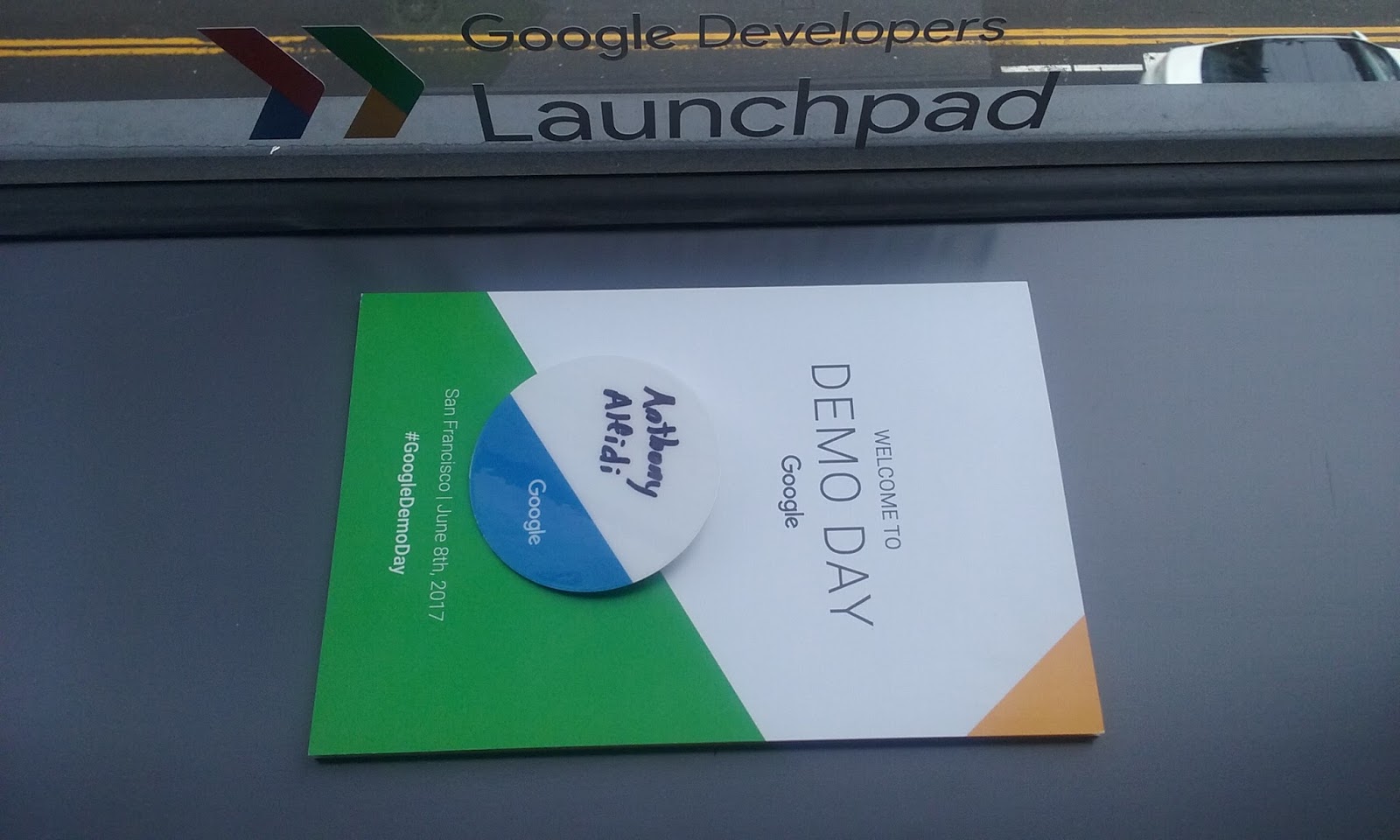
Google Launchpad gave out booklets on Demo Day 2017.

I took away some pretty clear lessons for startup founders based on the give and take between the judges and the pitching startups. Target your first vertical aggressively. Know your biggest competitors (how to position yourself, and how they'll counter you). Clearly explain your user experience (UX). Briefly walk through a successful use case from a paying customer. Know your capital requirements and how scaling up will affect both capex and opex. Explain how your solution shortens a customer's procurement decision cycle, which will be longer in some hardware-intensive verticals.

The implied tasking for entrepreneurs who need to forecast capex and opex is to either thoroughly know financial analysis prior to launch or bring on a CFO immediately after raising Series A. I have mentored a few startup founders through the basics of business finance. It is not child's play.

The VC judges picked a winner among the pitching candidates, and I was pleasantly surprised that it was the one I picked as a winner before they voted. See folks, I do think like a VC. The winner was a financial market application, so I admit my natural bias in seeking something in my sector, but a few other startup candidates had some decent ideas. One idea that I thought would go nowhere was too easy for established competitors to duplicate.

Hey Google developers, you're going to see me at the Launchpad a lot more now that I know its location. I really like the shiny, snazzy name badges they sometimes make for attendees. I should get a permanent one since I plan to be there so often.

Wednesday, May 31, 2017

Alfidi Capital at LAUNCH Festival 2017

The legendary LAUNCH people held their LAUNCH Festival 2017 at the Palace of Fine Arts in San Francisco. I never pass up a chance to attend a major conference in my town. I attended to check out the latest and greatest tech aspirations. I spent roughly equal amounts of time at the Scale Stage, where scaling and growth hints were hidden inside pitches, and the Main Stage, where startups competed for venture investors' accolades. My adoring readers get to absorb the tons of free wisdom I collected. I emphasize "free" because I was too cheap to pay for a VIP ticket.

Alfidi Capital sees the main stage at LAUNCH Festival 2017.

I have probably seen the Internet slang "TL;DR" before but seeing it at LAUNCH Festival made me want to look it up to refresh my memory. It means "too long, didn't read," alluding to people's short attention spans and their disinterest in reading lots of text. I don't write for those people so they can go away. One tech speaker advised entrepreneurs to buy ads outside their competitors' locations, presumably because their customers will see it and switch to the new product. I guess that works if your competition has brick and mortar stores you can locate. Another guy said that financial partners dislike P2P payment systems due to connotations of illicit activity, but I think that's an illusory pain point that Google Wallet solves.

Here with go again with the KPIs, people. Your KPIs must measure how app engagement leads to conversion; any iterative changes in UX or shopping cart stages to checkout must be justified by conversion improvement and revenue growth.

The pitches that resonated with me were often from people who could cite examples of their GitHub work. GitHub code samples are an emerging example of the future of employment verification and job qualification. IMHO LinkedIn (now a Microsoft property) must catch up by featuring work samples more prominently.

Red Bull was popular at LAUNCH Festival 2017.

I keep hearing way too much about how job candidates and acqui-hires can write their own tickets in negotiations. That might work if you're a legendary coder with an arm's length list of hackathon victories or grey hat penetration tests. I would like to find a respected book or white paper on compensation negotiation that's data-driven and peer-reviewed, not just some business press baloney.

It's interesting how tech subculture recognizes laziness among DevOps engineers as a desirable work trait. The preference acknowledges that techies with a strong interest in gaming and social media will solve business tech problems quickly and effectively, so they have more time to goof off. I would like to see this dynamic in action at a real startup workplace.

Nir Eyal caught my attention at LAUNCH Festival when he discussed lessons from his book Hooked. The hook/trigger, action/reward cycles drive emotional investments people make in their preferred services. Mr. Eyal noted that these habit-forming steps are at the core of business processes that Facebook, YouTube, and Google used to rapidly scale up from startup to huge successes. I believe startup founders can use his behavioral lessons in conjunction with their CustDev case studies to design addictive solutions.

It's never to early to think about exits, according to the gurus on hand. It's no secret that M+A strategies still favor acquisitions over IPOs for venture-backed startups. I always thought it was because the public disclosures and roadshows for IPOs require more involved work than the private market due diligence a buyer performs in an acquisition. One of the LAUNCH speakers opined that startups should think about which phase of their growth qualifies them to be in an acquiring corporation's due diligence pipeline. I thought the speaker was too limiting in stating that a Series B raise with a mature partner ecosystem was the sweet spot. The speaker also thought that a founder's yearlong relationship with the prospective acquirer's CEO builds trust leading to an acquisition. I guess that favors Stanford and Berkeley grads in the Bay Area, since those are the feeder schools for Silicon Valley's hottest startups and the venture firms backing them. I totally grok the admonition to keep startup board members in the lop on exit discussions and finding an acquirer with a matching business development strategy.

I am really convinced that corporate development people are just dumb trend followers after hearing about how "hot product" market validation often triggers a wave of interest in similar rapid acquisitions. It also implies that the work they do may be little more than supporting their CEO's confirmation bias if said CEO already has a favorite founder relationship in mind. I could point these CEOs to academic studies that most M+A deals fail to add value, but that would just upset them if they have their hearts set on deals with college pals running hot startups.

I paid close attention to the Investor Outlook speakers, because I'm an investor and someday I'm going to buy and sell everyone's sorry behinds like they're a bag of cheap candy. Here comes a blast of random commentary. Venture capitalists with operating experience have insights into product rollouts and recruiting scale-ups that matter to early stage growth startups. It occurred to me that I've never seen an ugly-looking VC firm partner; they all seem remarkably handsome. I shake my head hearing VCs wanting to pivot to AR/VR and agtech if they only have software experience; they don't know these verticals! Agriculture scaling is not the same as enterprise software scaling. The latest blockchain baloney is "ICO tokens" for crowdfunding, yet another misapplication of open-source transaction ledgers as nonviable currency. It's good that VCs are more interested in helping startups solve growth problems than in just doing financial engineering. It was interesting to hear one VC liking podcast monetization; IMHO voice and audio content like podcasts and audiobooks are an underutilized stream. The underutilization may be due to the difficulty of searching audio online. Audio needs better search, analytics, meta-tagging, and delivery platforms. I say the podcast revenue model could resemble freemium app revenue, with ads embedded somehow (perhaps with a visual tag on the audio console, similar to YouTube channel ads). Let's get back to the handsome VCs for a moment. They seem to like wearing expensive designer clothes with a casual chic, showing of wealth while implying they can be as informal as startup founders.

The LAUNCH Festival was the perfect opportunity for startups to show their wares at tables, booths, and pitch stages. I picked up literature from people pushing forestry drones and DIY hedge funds. The whole mash-up demonstrated why I have t live in this town and nowhere else. The next bonanza was somewhere on the expo floor. All the festival needed was some gourmet food trucks on site so the lunch lines would not have been so long. I'll be looking for those trucks at next year's LAUNCH Festival.

Tuesday, February 16, 2016

Saturday, February 06, 2016

The Haiku of Finance for 02/06/16

Pointless gathering
Startup marketing wasted
Low maturity

Clueless Tech Scene Partying Away Super Bowl 50

You may have heard that Super Bowl 50 is playing in the San Francisco Bay Area this year. I still think the football team that used to call San Francisco its home should change its name to the Silicon Valley 49ers, but that can wait.  The weekend build-up to our nation's prime secular festival transformed part of downtown San Francisco into something resembling a clean, normal city. I had very little to do with the festivities other than accept an invitation to a pre-party. The tech startup sponsoring the party had a chance to display competence and blew it.

The startup's app is completely dependent on data feeds and user interactions from another well-known tech company. The relationship resembles Zynga's early dependence on Facebook but even more tenuous and economically unjustifiable. I asked this particular startup's marketing person if they could survive without being parasitically attached to their host body. The person had no idea. I asked about their monetization strategy. They had none. I offered my observation that startups devoid of monetization paths typically disappear rather quickly. The twenty-something marketing person had no concern at all, as if the capital entrusted to their startup by early-stage investors was a lifestyle gift.

Ladies and gentlemen, the entire second wave of dot-coms that are about to crash and burn is populated by the kinds of people I meet at these tech mixers. Many of them have no business expertise, no planning ability, no marketing sense, and nothing besides some mediocre tech skill they extrapolate into a flashy single-purpose app. I did not see any point to this particular pre-party other than to have a good time on someone else's dime. I can even assess the startup team's immaturity by how ready they are to start their sponsored party. Chips and booze are not hard to come by but their late arrival reveals a startup founding team that has never performed basic logistics tasks. Hey kids, throwing a party for partners, analysts, and investors is not as easy as pulling a beer out of your parents' fridge.

Super Bowl money really cleaned up this town. The City finally found someplace to put the homeless this weekend besides in the way of tourists. Many of the tech people "working" their way through Silicon Valley startups stand a good chance of becoming homeless themselves in the next couple of years. Their lack of business acumen gives me short-sale opportunities, plus open social events where I consume free food and booze. I can eat and drink any of them under the table.

Thursday, January 14, 2016

Monday, January 04, 2016

Monday, December 21, 2015

Financial Sarcasm Roundup for 12/21/15

Here comes the special Christmas holiday 2015 edition of my sarcasm. Tonight I spent a brief interlude at CoInvent's holiday party at General Assembly's San Francisco office. The party was fine and I got my fill of free booze. I can't complain about parts of the startup ecosystem that competently execute their business models. I can only blast some sarcasm at other parts of Silicon Valley culture that are not living up to their reputations.

I spoke with one longtime contact at tonight's party who sells office furniture. He remembers the 2001 dot-com crash all too well, and how easy it was to pay bargain prices for like-new high-end office furnishings. I mentioned the recent deflation of a few unicorn startups, you know, the ones with undeservedly high valuations. I'm pretty sure he can expect loads of office bargains coming his way soon as other unicorns fail to deliver on their early investors' expectations.

Everyone I met had something to pitch. Anyone who arrives at these types of things without a pitch should think of one really fast. My pitch was "I want free wine," and lo and behold the free wine materialized right in front of me. That was fast. I didn't even have to ask. I did ask for free food but none was forthcoming. Only one of my two pitches was effective.

The CoInvent holiday party intended to raise money for Charity: Water. I am all in favor of building clean water projects in developing countries. Before you know it, those underprivileged folks will be watering lawns and washing mud off SUVs just like we do here in the U.S. We can then teach them something about water conservation after they've wasted all of the water they never knew they could pump.

San Francisco tech events just aren't the same if I'm not gracing their presence. Techies flock to hear my wisdom when I attend anything. I celebrate the winter solstice with my own personal Saturnalia that lasts as long as I feel festive. Ancient people worshiped the gods of nature. Modern people worship the god of tech and finance . . . that would be me, yours truly, Anthony J. Alfidi.

Wednesday, November 11, 2015

Monday, November 09, 2015

Thursday, November 05, 2015

The Haiku of Finance for 11/05/15

Pulling all-nighter
Prep pitch for next angel round
Bullet points raise cash

Saturday, October 31, 2015

Saturday, October 24, 2015

Sunday, October 04, 2015

More Thoughts On Launching API Startups

My experience at Integrate 2015 got me thinking about how APIs and other elements of the data supply chain can be stand-alone enterprises. I will throw my thoughts from our VC perspectives panel out on the Interwebs to see if any of them stick to entrepreneurs.

The successful API supports an app ecosystem. Other businesses in related sectors code their own apps to share affiliate revenue with the API owner for every transaction their apps process. Airlines and hotels build apps around Uber's API because their customers see value in having a short-haul transportation link. Uber's app ecosystem becomes a durable competitive advantage because the app owners would have to build a whole new app if another virtual taxi company tried to displace Uber. Digital infrastructure like apps impose some switching costs on partners, but those costs are probably not insurmountable for competitors.

One thing making APIs a core business model is the continuing integration of cloud, mobile, and Big Data solutions. Some parts of this convergence are coming along fine, like the analytics suites now part of most middleware. Other parts are not working because venture capitalists have wasted lots of money on startups with lame mobile concepts. Venture funds can force their portfolio companies to pivot from a mobile or cloud solution when something isn't working out. That's how they try to save their investments. Targeting APIs for venture investment means the least successful among them will be candidates for forced pivots.

I like startups that understand Customer Development, the Business Model Canvas, and Cloudonomics. Founders should download those white papers, hit the books, and work the equations. Revising the API business plan after working those three areas shows investors that they take de-risking seriously. Corporate development groups in particular carry marching orders form their enterprise mothership to fund startups that improve their internal KPIs and match their product lines. Startups can use Cloudonomics calculations to prove their APIs are a better investment. Cloudonomics is as compelling for IT as modern portfolio theory is for finance, because it offers a disciplined methodology for allocating limited capital among a potentially unlimited number of investment options.

I do not like startups that do not understand the new opportunities and risks of raising capital under the JOBS Act. The SEC continues to publish new rules defining what private companies can and cannot do to attract investment. Anything I blogged about in the past regarding crowdfunding will likely be obsolete by the end of 2015 as the SEC finishes its unfinished business. Startups will have to engage competent legal counsel earlier in their development process to understand JOBS Act compliance. Founders must meet all of the SEC's compliance requirements before they appear in front of pitch fest panels or hang pitch decks on crowdfunding portals. No one wants to be shut out of raising capital because they did something noncompliant.

Data sector startups can tell their stories more effectively by having a founding CEO who knows sales. It really is that simple. Technical founders love solving technical problems, but they may not know how to solve problems with financial or emotional components if they have never worked in sales. It goes back to the classic split in startup teams between the scientific co-founder who becomes the CTO and the MBA-type serial entrepreneur who becomes the co-founding CEO.

If I only had so much money to commit to a venture investment, I would prefer Big Data and cloud concepts over APIs or IoT. The industry standards for data and cloud are firmer than those for APIs and IoT, so the durable competitive advantages of a given business model will be clearer where standards are firmer.

No enterprise can ever indemnify itself by outsourcing risk. Trusting an untrustworthy partner brings a boatload of risk assumptions. Outsourcing an API means trusting someone else's coding with no supervisory input. If the API passes dirty or fraudulent data into analytics, the enterprise's compliance regime becomes a target for regulators. Don't ask for trouble by handing off mission critical API management to a third party.

Chew on all that stuff, API people. There's enough genius here for several weeks of boardroom discussions. Barriers to entry in API development are pretty low, just like in gaming, because the only immediate limit is a developer's imagination. The API businesses will be the next big thing in the mobile Big Data cloud.

Tuesday, September 29, 2015

Thursday, August 13, 2015

Tuesday, July 28, 2015

The Haiku of Finance for 07/28/15

Startup cash burn plan
Spend it all, then ask for more
Investors just laugh